Showing posts with label gas. Show all posts

Tuesday, 2 April 2024

Relative cost of heating with a heat pump vs. gas (How to reduce your heating bill by 100%)

We've now had our heat pump for one whole winter. For the purposes of this blog post, "winter" refers to each period of November through to and including March, as those are the months when we use heating. Because we've gone through our first winter period with the heat pump we can now make a comparison with other winters when we used gas for heating and work out both the financial cost and (more importantly) the emissions due to both heating options.

This house was cold
We've lived in our home since 2007 and I've recorded our energy consumption consistently each month. Our home was built in 1972, just after the discovery of gas under the Netherlands. At this time it was assumed that gas would always be an inexpensive fuel source and no-one was making much effort to make housing efficient. We had very little insulation and single glazing in most of the windows. Only the living room, dining room and kitchen had old and basic double glazing.

When we worked out how much the first winter's energy bills were going to be this really shocked us and we ended up setting the thermostat as low as 14 C and in order to reduce the gas consumption we even turned the heating completely off on some of the coldest days of winter until our children were about to come home from school. This was quite unpleasant so we started some steps to insulate our home even in the first winter in order to reduce the energy requirement.

Each insulation job contributed to reduced heating requirements and a warmer house. At first there isn't much of a reduction in consumption to see, but that's because we were compensating by living with a bit more warmth each winter. The difference between the blue and red line was the consumption of the pilot light in an old gas water heater that we replaced with an electric water heater last year.

By the winter of 2022/2023, the last in which we still had a gas connection, our heating consumed just 287 m3 of gas rather than the average of just over 1110 m3 of gas per winter that we had burnt over the first four years that we lived here. That's about a 70% reduction in energy input, without changing the heating system.

This winter we used an air-air heat pump in our living room as almost the only heat source between November and March. There's a heated towel rail / IR panel in the bathroom which comes on with a timer every morning but otherwise no permanent heating upstairs to replace the no longer used radiators. We did make very occasional use of portable electric heaters. We've been quite warm. It's certainly far more comfortable upstairs now without any heating than it was in the first years that we lived here when hot radiators struggled to keep uninsulated bedrooms with large single glazed windows up to a comfortable temperature.

Energy consumed
Our heat pump consumed 682 kWh of electricity over the five month winter period. That's roughly equivalent to the energy content of 68 m3 of gas. i.e. this winter we used only about 6% as much energy to heat our home as was the case when we first moved here.

I have to admit that this was not a particularly cold winter, but it was especially grey and wet so the solar panels that were supposed to run the heating didn't do as well as was expected. Despite that, even this winter, they still generated more than 30% of the electricity that we consumed over those five months so we had to buy just 470 kWh of electricity from the grid to run our heating.

CO2 output
We're signed up to a green tariff which promises us 100% green electricity ("100% groene stroom uit Nederland") but I never know if you can really trust such a claim so I will instead take the an average carbon intensity of 223 g per kWh for Dutch electricity in 2023 as a worst case scenario for our CO2 output.

That worst case scenario suggests that our heating may have produced 105 kg of CO2 this winter (470 * 0.223), which is a huge reduction compared with the emissions of our gas boiler when we first moved in. Our gas heating CO2 output averaged around 2000 kg of CO2 per winter over the first four years that we lived here. i.e. the worst case scenario gives us a 95% reduction in CO2 output for heating due to a combination of insulation and electric heat pump replacing the gas boiler. The first 75% or so of that reduction in emissions is due to the insulation and the heat pump is responsible for the rest.

What would it have cost if we were still using gas ? What has it cost this year all-electric ?
We could never afford that level of gas usage so we shivered more than most when we first came to live in the Netherlands. If we'd continued burning gas at the rate that we did in the first four years that we lived here then it would have cost over €1600 for heating this winter. Instead of this, we insulated our home in order to consume far less heat. If we had stayed as we were last winter, with the same insulation but with gas heating instead of the heat pump, then we'd have consumed about €400 worth of gas over the winter period. That's already quite a saving over the average.

According to our energy supplier, the gas consumption of an average home like ours (semi-detached / 2 onder 1 kap) over the winter period is around 1360 m3, which is actually higher than what we found unacceptable when we moved here.  At the current price of gas quoted by the energy that gas costs an average family in an average house like ours about €1930 each winter and each of those homes will produce over 2400 kg of CO2 for heating over that period.

But our gas supply was removed last year and we're all electric now, so what did it actually cost us to heat with the heat pump ?

For the last year we've been paying our energy company €5 per month for the electricity connection only (there is no gas connection). We've just come to the end of the yearly billing period and they now owe us more than €200 for the excess electricity that we produced from our solar panels and contributed to the grid. i.e. our energy bill is negative.

End of year summary from our energy company. They owe us €252, and we can continue to pay them €5 per month next year.

Insulate ! It makes a huge difference to your comfort and your bills. Then you can install a small and inexpensive heatpump.
Every step that we've taken in the past to better insulate our home has led to lower bills, lower CO2 output, and more comfort. It took us a while to do everything because our income is small so we couldn't do it all at once. But do everything you can, as soon as you can. It's really worthwhile to do all of this before you even think of replacing the heating system.

If you're in a rented home that makes things more complicated, but encourage your landlord to everything they can. This is a no-brainer for any sensible landlord as any work done adds to the value of their asset. If you're in an apartment and shared ownership of walls and roofs is a problem, then do whatever you can to get the organisation (probably a VVE in the Netherlands) to make changes. That's a difficult situation because you have to get a lot of people to agree. But it's all worthwhile. Every penny spent on heating is wasted, every penny helps to pollute the planet, so let's stop spending so much on it.

Reducing energy input
Something that seems quite crazy to me is that people replace absurdly oversized gas-powered boilers (ours was rated at 28 kW!) with equally absurdly oversized heat pumps. Yes, they'll cost less to run and have lower emissions than gas heaters, but they still consume a lot of electricity. Those high powered heat pumps require a three phase connection (single phase is limited to 16 A / 3.5 kW in the Netherlands) in order to suck in enough current to produce their huge outputs. What we installed has a 3.5 kW maximum output and it consumes a maximum of about 1 kW when it's in use. It it really warms the room up quickly when it starts up, but it soon settles down to a lower power mode to maintain temperature.

I think it's important that we try not only to switch away from fossil fuels but also to reduce our total energy consumption. The energy transition certainly won't be made easier if we try to achieve that transition by installing lots of electrical devices which consume enormous amounts of energy.

Once a house is well insulated it just doesn't need much heat input. At that point, an inexpensive air-air heat-pump like ours can keep your home at a comfortable temperature. Our heat pump and everything I needed to install it myself together cost significantly less than one year's average winter heating bill. The result of installing this device is that we no longer have a heating bill. Why would anyone not try to do this if they can ? We may now install a second one upstairs in the room where I work, but that's really a luxury: I've been fine this winter. If I didn't work from home I'd probably not be considering it at all.

Wednesday, 23 August 2023

An all-electric home with air conditioner (aka air-air heat pump) as heating

Regular readers will know that we had the gas supply removed from our home in April this year. This left us with no central heating in our home. We used a portable 400 W electric infra-red heater in he living room on some of the cooler days of March and April, which worked well enough for those months because our home is now very well insulated, but we knew that in the middle of winter we'd need a more effective form of heating. Having the gas supply taken out meant that we were working under a time constraint - we had to find a solution before next winter. We now have that solution.

Electrical heating
Electrical heating is 100% efficient. All the energy which goes into an electric heater will be turned into heat. Actually, the same thing applies to all other electrical appliances - some of the energy may turn into mechanical movement, calculations, light, sound etc. but it all becomes heat in the end. So everything electrical helps to heat your home at almost exactly 100% efficiency (we lose a tiny bit from light shining out of windows and other small effects).

But just because resistive electric heating is 100% efficient that doesn't mean it's actually a particularly good way of heating your home. Electricity costs more per kWh than gas. Also if gas is being burnt to generate electricity then due to inefficiencies of the power station and transmission lines more gas will be burnt in total to heat your home than would be the case if you had an efficient modern gas central heating boiler.

For a while, around 50 years ago when the future looked like it might be nuclear powered, the idea of storage heaters was popular as they would allow excess "too cheap to meter" electricity generated at night by non-throttle-able nuclear power stations to be used as heat during the day. Homes in the UK were built as "all electric" and I lived in some homes with that type of heating. It worked reasonably well. There was a logic to it, but nuclear is not a technology which is going to come along and quickly save us from ourselves right now. Many of those homes were later retrofitted with gas, which now looks rather unfortunate. Our home in the Netherlands has gone in the opposite direction. Built originally against a promise of cheap endless gas, we've transformed our home to be fully electric.

Heat pumps
Heat pumps on the other hand are popular now. They appear to do something magical in that they generate more heat energy in their output than they consume as electrical energy from their supply. There is of course no magic involved at all. In this house we obey the laws of thermodynamics and we're not creating something out of nothing. Heat pumps actually (mostly) just move heat around. When heating a home in the winter they take heat out of the already cold air, water or ground outdoors, making it even colder, so that that heat can be emitted indoors. It's a neat trick.

The problem with heat pumps sold to replace central heating boilers, providing hot water to flow through radiators or under-floor heating, is that they're very expensive and they're over-sized for many well insulated homes. When I calculated how much gas we burnt last year to heat our home it became obvious that the 28kW gas central heating boiler installed in our home had only burnt enough gas to have operated at full power for the equivalent of about three days in the whole year. The lowest output heat pumps are rated at around 7 kW so one of those would have to run for about 10 days in the year. It would still lose a little in efficiency because the boiler would be on the top floor and the hot water would still have to be piped two floors down to reach the living room, losing some of the heat along the way (even with well insulated pipes), but total energy consumption would be 400 kWh over the year. By comparison, direct electrical heating to provide the same amount of heat would consume about 2000 kWh of electricity in total.

Air conditioners
Air conditioners work in exactly the same way as a heat pump. Many models of air-conditioner can also operate as heaters and when so used they have the same high efficiency as heat pumps. i.e. they produce far more heat as output than they consume from the electricity supply. Even though they don't attract a subsidy they have a much lower price than a heat pump, so we decided to install an airconditioner as our source of heating in the winter.

We could have installed two air conditioners, one up and one down, but we're instead going to try to live with just one in our living room together with occasional use of a portable electrical heater upstairs should it prove to be necessary. We have rarely turned on the upstairs radiators in our home in the past so we clearly don't have much need for heating upstairs, but if it turns out to be necessary nothing excludes the installation of a second air conditioner upstairs. Two air conditioners still cost only about half the price of a heat pump.

The nasty environmental problem with air conditioning and heat pumps
One of the things that has put me off both heat pumps and air-conditioners in the past is the high environmental impact of florinated refrigerant gases. These not only have a disastrous effect on the ozone layer but that also can have a greenhouse effect greater than 10000x that of an equivalent amount of carbon dioxide (GWP = global warming potential). Even the R32 refrigerant often touted as environmentally friendly has about 670x the global warming potential of the same amount of CO2. 

While it's supposed to be the case these days that refrigerant is recovered when airconditioning systems are taken out of use, does that actually happen in reality ? Photos showing destroyed airconditioning units dangling from buildings in war-zones and after natural disasters indicate that a considerable number of these units don't get decommissioned in a manner which is sympathetic to the environment, and even if they are, what do we do to ensure that those gases never escape once they are extracted from an old airconditioner? I'm not convinced that these gases can be contained for the rest of time and do all the old gases make their way safely to one of the few plants which can destroy them ? I don't think I'd like the answers to these questions. Luckily, there is an alternative:

The solution: R290
R290 is a refrigerant with a GWP of just three. Not three hundred or three thousand, just three. On release it has a greenhouse effect only three times as bad as CO2 and it has no no effect on the ozone layer. There is very little refrigerant in an airconditioner, less than half a kg. As such, the total harm than can be done by releasing this gas is very small. R290 is actually just propane, so not a florinated gas at all. As a result of this it's also legal for people to work on R290 systems themselves. No "f-gas certificate" is required for working with R290 here in the Netherlands because it is not an "f-gas". DIY is good - it should reduce the total cost and I like doing stuff.

Our choice of airconditioner
R290 split airconditioners have been promised for some years but they still seem to be new on the market. I picked the only model that I could find on the Dutch market earlier this year, a Midea 3.5 kW air-conditioner. This was the first model of airconditioner ever to win German Blue Angel environmental certification. It took a while to find a supplier as seemingly not many people sell them, but I did find a supplier in the Netherlands.

As this airconditioner has an SCOP of 5.2 it will in principle consume only about 400 kWh of electricity a year to provide as much heat directly in our living room as our old central heating boiler put into hot water which it then pumped around the house. It should operate efficiently down to -15 C which is almost as cold as it's ever been here. It's never been that cold for the entire day. But anyway, if it gets really cold I guess we'll have to go out cycling for a bit to warm up.

To provide power we already expanded our solar power installation with two extra solar panels which will produce about 700 kWh of electricity a year. In total we should easily generate enough electricity each year to supply the air conditioner as well as the electric water heater (for which we installed another two solar panels) and every other electrical device in our home. While in winter months even our over-sized solar setup won't generate enough to run everything, the overcapacity should mean we are able to operate at least mostly on our own electricity for most months of the year.

Now some DIY
The airconditioner turned up a couple of days after ordering and then I ordered a few extra parts to complete the installation.
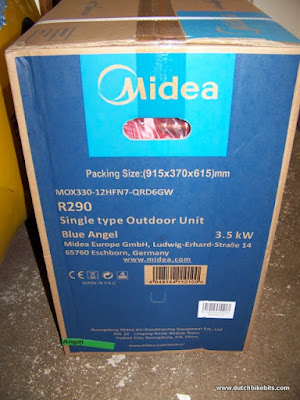
The outdoor unit in a box. Clearly labelled R290 / Blue Angel. Quite heavy to move.

I needed refrigerant lines and electrical cable and I chose rubber feet for mounting the outdoor unit on the ground outside our home. We could have mounted it on the wall but I thought that brought a higher possibility of vibrations being carried into our home (the unit doesn't vibrate much and I now doubt this would have been an issue). Also the wall mounting brackets available didn't seem to be large enough to allow enough space. The outer unit is recommended to be installed 30 cm from a back wall for maximum efficiency.

The first thing was to determine the best place for the inner unit. I decided to place it half way along our living room wall and so high as possible. The instructions suggest a minimum of 15 cm between the unit and the ceiling and that's about the height at which it's mounted. I didn't want visible ducting inside our home so I drilled a single large hole through which all the pipes and wires had to run. This had to run downhill to the outside in order to make sure that the condensate would find its way out through the wall, and in my case I had to run it at a more extreme angle than I otherwise would have because the carport outside our home is attached to the outside wall at the same height as the inner unit of the air conditioner is on the inside wall.
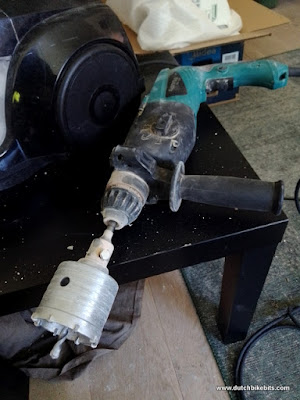
Drill with 70 mm attachment for drilling through concrete. This does not go through in one push. You have to work at it a bit, and stop to let it cool down quite often. You also have to pull out chunks of concrete and brick which fill the tool and stop it from working. It took more than an hour to drill the hole. I had to work from both sides as the wall is over 30 cm thick so I first drilled all the way through both layers of the wall with a long 12 mm drill bit.

Hole in the wall, sloped downward to avoid the carport outside. I lined the hole with PVC pipe, cut lengthwise so that it could adjust to the right shape and sealed with PU foam. Note: a lot of concrete and brick turned into dust. I worked with a mask on as well as ear defenders and had a vacuum cleaner running continuously, which helped to avoid too much dust finding its way elsewhere in our home.

The refrigerant tubing comes as a reel of copper pipe with insulation already fitted. I was cautious of bending this copper tubing as I'd expect it to flatten if bent too sharply but it unwound without causing any harm to itself and could be poked through the wall to the other side also without harm. I could then attach the pipes on the outside to the external unit. In my case exactly three metres of pipe was required. This was supplied with the required flare to fit both units, making the job a bit easier.

Black plastic covers on the piping of the indoor unit. The indoor unit has high pressure nitrogen inside so there is a hissing noise when they are loosened. That does not mean that refrigerant is leaking - the refrigerant is in the outdoor unit. However it's important that there should be a hissing noise as that indicates that the indoor unit has held pressure, also that it's not been contaminated with damp air. This didn't seem to be written down anywhere so I thought I'd add it here.

By this stage I'd put everything together so that in theory it was ready to go, I then tried to find a contractor to carry out the final step: Before you can set an airconditioner into operation it's necessary to draw a vacuum in the pipes so that there is no air in the system. Only after that has been done is it possible to release the refrigerant from the outdoor unit into the system. Some people don't bother with this step and I assume that their airconditioners don't operate to their full potential as a result.

I didn't have a vacuum pump and I thought it reasonable to let someone with experience do this part of the job for me. I even thought it might save a bit of time. However that turned out not to be the case at all. This was the most time consuming part of the whole project ! I waited over a month for more than ten different contractors to get back to me. They either said they would only with a certain manufacturer's airconditioner, or they wouldn't check other people's work, or they said they were too busy. Eventually, one guy said he'd come and do it. He made an appointment for two weeks in the future... and then he didn't turn up. So this was also to be a DIY job.

The standard price for setting an airconditioner in action is €200. That's what everyone who said they could do the job said they'd charge me, though none of them seemed to need the money. In the end I bought a vacuum pump for €115 expecting to need adaptors and pump oil in addition, but it turned out that everything I needed was in the box with the vacuum pump. This was a very simple and quick job to do, apart from the waiting around. No more than half an hour of actual work.
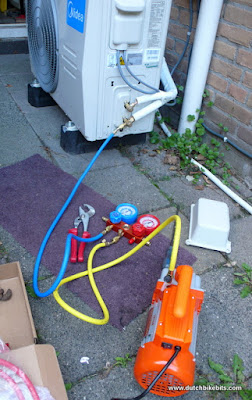
Vacuum pump pulling the air out of the tubing. After half an hour I turned off the blue tap and disconnected the yellow hose.

, which was never an option
The next morning we still have "-1 bar" relative to ambient air pressure so it didn't leak (i.e. close to 0 bar in reality negative pressures can't exist)

So the pump was set up and drew a vacuum for half an hour. I then I disconnected the pump, leaving the pressure gauge displaying -1 bar overnight. After that I let some of the gas into the system, the pressure rising to about two bar so that I could check my connections to the pipework with soapy water to see if there were any leaks (which I'd have to tighten up before going further). There were no bubbles forming so I let the rest of the gas into the system, still no bubbles, then I removed the meter from the outdoor unit, fitted all the covers and switched on. The airconditioner works.

Outdoor unit. The white cover over the cables and tubes goes to just slightly underneath the carport. The inner unit is on the other side of the wall a few cm higher. The switch on the wall is a legal necessity. The watering can catches the condensate so that we can use it in the garden. If the air conditioner is set on cool mode for an hour it produces a surprising amount of water.
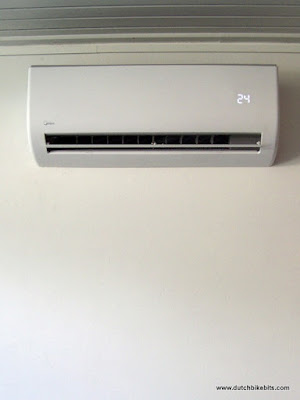
The inner unit on the wall in operation. No visible wires or tubes. Everything works. We've used it to cool a couple of times and it's very effective. Heating has been tried only momentarily because it's summer and we really do not need heating yet. Hopefully this will work as effectively as we need it to in winter. It's very quiet in operation. Almost nothing to hear at all, certainly much less noisy than a table fan even on a low setting. The displayed temperature is what we were cooling to in the summer, not what we heat to in the winter.

We have a heating solution!
So we now have a heating solution for next winter. It will consume less electricity than a heat pump but hopefully provide us with enough heat. It's a bit of an experiment for us to say that we're only going to heat the ground floor, so wish us luck. The kitchen is a bit of a worry because it's around the corner from the living room and dining room. But the kitchen also has other heaters in it, such as a small water heater under the sink, the refrigerator etc. The extra insulation job that I did on the kitchen door a few days ago was specifically intended to try to keep the kitchen warm when we are heating just the living room. We have other plans and there are more things that can still be done. Watch this space.

Did I forget to mention summer ? We installed this air conditioner primarily to provide heat in the winter, but obviously an air conditioner can also be used as an air conditioner. We have done that for a couple of afternoons when it was very hot and I have to say that it's very pleasant to have a cooler home when it's hot outdoors. Luckily these times also coincide with our having excess solar power and the grid being quite full due to the amount of sun beating down on everyone's homes, so we find ourselves still exporting electricity while the airco runs. I don't see a downside to using the air conditioner in this way sometimes. With weather becoming more extreme we might well use it more often. But we don't intend to live in a permanently air conditioned home. When the weather allows, it's much nicer to open the windows.

Getting rid of the radiators and central heating boiler
A job that I've not yet done is to get rid of the radiators and central heating boiler from our home. There's a lot of metal involved, a lot of heavy work. They take up a surprising amount of space. We didn't get rid of these things when we first had the gas removed because that would mean burning a lot of bridges. We might have decided to install a heat pump instead of air conditioning, and that could have worked with our existing radiators (which are oversized to suit our originally under-insulated home). While I'm quite confident, this also means that if the air conditioner doesn't work out this winter, we could still make use of the radiators next year with a heat pump. There's no need for us to rush this.

Car airconditioners
What's the deal with car air conditioners ? From what I can tell these leak all the time and drivers respond by having them "topped up" with more refrigerant, sometimes annually. If there's a crash (and there are always crashes) then the refrigerant is released and having its awful effects on our climate and the ozone layer. Air conditioning in cars really should not be allowed, certainly not with use of refrigerants which are more destructive to the environment than R290.

Cars make everything worse.

Update: The first cold month - November 2023
November this year was colder than usual. We had snow and persistent freezing temperatures which we've not had in November for many years. There was also very little sun. So how well did the heat pump work ?

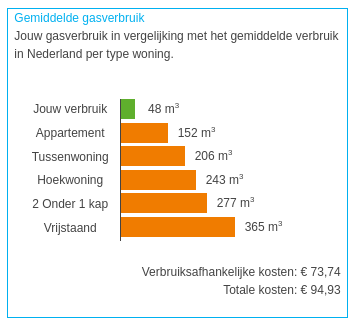
Gas usage November 2022. We consumed 52 m3 of gas, compared with 119 m3 for an average apartment and 217 m3 for an average house like ours.

In November 2022, which was warmer than this year, we used 52 m3 of gas for heating. That was less than half the amount used by an average apartment in the Netherlands. This year we substituted 105 kWh of electricity consumed by the heat pump. 105 kWh of electricity is equivalent to the energy released by burning about 10 m3 of gas so we're now heating our four bedroom semi-detached home with about 1/10 of the energy required to heat an apartment.

And the CO2 footprint ? Burning 52 m3 of gas results in the release of 92 kg of CO2. The average gCO2/kWh for the Netherlands in 2022 is 321 g so consuming 105 kWh of electricity results in the release of 33.8 kg of CO2 on average. That's about a third of what we produced last year with gas. But even with the particularly grey weather that we've had for the last month we still generated 1/4 of the electricity that we used from our solar panels (and we used 80% of that directly, not relying on the grid too much as a "battery"), which brings us down to around 25kg, or not far from a quarter of last year. We're signed up to an energy contract which promises "100% green" electricity but while that provides a stimulus for green energy producers it doesn't really change what comes from the grid. I hope of course that we're at least providing a push towards producing greener electricity.

But even in the worst case we're looking at a far lower CO2 output than the 386 kg which an average semi-detached house like ours produced last November.

Tuesday, 21 March 2023

Having the gas disconnected

Having the gas connection removed from a home in the Netherlands costs €869, except that it's subsidized at the moment so costs nothing at all. What better time can there be to remove fossil fuels from your home ? Our gas supply will be cut off in a few weeks time.

It's taken us a bit longer than I'd hoped to get to this point but in a few days our gas supply will finally be cut off. We stopped cooking with gas many years ago, but we still had gas central heating and a gas hot water heater for our shower. It was the latter which stood in the way of getting rid of gas altogether as having no hot water in our bathroom at all, especially over winter, was not at all appealing. However we installed an electric water heater last month which then meant we no longer had a good reason to still have a gas supply to our home.

How much gas, how much CO2 ?
For some odd reason our energy company decided that our annual summary of energy usage should be over a period of February 23rd 2022 to March 11th 2023 this year. That's two weeks longer than a year and includes more of the cold days. The summary shows that we consumed 540 m3 of gas. That's considered to be quite low, but it's still a lot. 540 m3 of gas emits almost a whole ton of CO2 when it's burnt (multiply cubic metres of gas by a factor of 1.78 to find how many kg of CO2 are produced), and that's something that we really do not want to do.

An absurdly over-sized boiler

In February we used 48 m3 of gas, about a third of an average
apartment or under a fifth of an average "2 onder 1 kap" (semi-
detached) home similar to ours.
This morning I worked out that the water heater which we removed last month actually accounted for slightly more than half of our total gas consumption for the year. Subtracting the equivalent of 12 summer months (when the central heating is turned completely off) from the entire years gas consumption suggests that only about 245 m3 of gas was used by the central heating boiler last year.

Burning 245 m3 of Dutch gas (at 33.32 MJ/Sm3) releases about 8163 MJ or 2270 kWh of energy. Our gas heating boiler is a Radson EHRE 240 from 1993 with a rated output of 28 kW. It's been obvious for years that it was grossly over-sized - I had to take action a couple of years ago to make it shut down sooner to stop us from getting too hot - but it wasn't until now that I calculated how absurdly powerful it was. A 28 kW output with consumption of 245 m3 of gas suggests that over the whole year this thing only actually operated for the equivalent of about 3 days at full power, spread over the colder five months of the year when we needed heating. i.e. On average it was used for less than half an hour a day.

The beast awaiting removal
Because we put a lot of effort into insulating our home, we can now make our living room and dining room (i.e. most of the ground floor of our home) heat up slowly with nothing more than a 400 W IR electric heater even on very cold days. Clearly we don't need anything like 28 kW !

The boiler dates from before condensing boilers were common-place. Its rated efficiency is 83%. It also doesn't have a balanced flue but instead takes air from the boiler room in which it sits (getting rid of it means we can insulate that room properly and gain a small storage room on the top floor) and as the heated water we receive from it on the ground floor has travelled two floors down to reach our living room and slowly gurgle around the radiators we clearly don't get the benefit of much of the 2270 kWh of energy released by the gas as heat in our living room.

So what now ?
We have decisions to make. Even a few small resistive electric heaters switched on when we're near them would be a more efficient way to hear our home. A friend of ours has reported good results from using an air conditioning unit to heat his living room this winter, and that's definitely more efficient than a resistive heater, but it does make a bit of noise. We will also need some heat upstairs, in the bathroom, bedrooms, work room etc. We've also been working on improving ventilation in our home so fitting a ventilation system with heat exchanger where the old boiler used to sit on the top floor would probably be beneficial. We have decisions to make over the coming months: By December it'll be cold again. 

Hoping to reduce our energy bill further
Last year a quarter of the total gas bill of €1051 was the connection charge. This year our gas bill will be much lower but it won't be zero as we'll still have to pay the connection charge for however long it takes to be disconnected. While gas cost us €1051 last year, our total energy bill for the year was only €587 once we took off the amount that the energy company paid us for nearly 900 kWh of excess electricity that we generated with our solar panels, as well as various other compensations and apparently random things that I've never understood which always appear on energy bills.

Anyway, the energy company decided that we had overpaid by €180 so they're sending us money, which is of course welcome. Then they set our monthly payments this year to be a bit higher than they were last year, which doesn't seem very logical under the circumstances, but they did this last year as well so I'll again have to argue it down this year.

We already added two extra solar panels at the end of last year to roughly cover the water heater's consumption and our plan now is to add a couple more panels again which should leave us with about 1600 kWh per year free compared with last year which we can use for heating. Hopefully that will be about enough. If we end up generating about as much extra electricity as the heating consumes, then not only will we no longer have any fossil fuels in our home but our bills should also be well on the way to zero.

Of course it's impossible to work out exactly what anything will cost because energy bills are absurdly complicated. While we work out how to reduce our energy consumption and CO2 output, perhaps the energy company can put some effort into making their bills understandable.

Job completed earlier than expected


Update 11th April: Our gas supply was removed this morning. Two gentlemen turned up with a digger and made a huge hole in the front garden, removed the supply pipe and the meter from indoors, and then they made everything neat again. So that's it - we no longer have any fossil fuel to burn.

In other news, I took delivery of two more solar panels a couple of days ago. So in a little while I'll write something more about our solar power system.

Over the summer we installed our heating system, a poor man's heatpump. This was too inexpensive to attract a subsidy but it should be enough for us.

Update: Someone was wrong on the internet. Me. So I fixed it.
Somehow I initially made a calculation suggesting that the gas boiler ran for only five minutes last year. This should not have got past my own internal 'smell test'. The boiler actually ran for the equivalent for about three continuous days and the blog above has been updated to reflect this. The other calculations were correct.

Wednesday, 8 February 2023

Electric water heating - finally got rid of the pilot light !

There's nothing much more boring than a photo of a cylindrical water heater hanging on the wall, but there it is boringly getting on with its job, heating the water for our shower and bathroom using solar power from our roof and our showers definitely don't mean burning gas any more !

Over three years have passed since I calculated how much gas the pilot light in our water heating system was consuming. It was a bit frightening. 134 cubic metres a year, That means the pilot light wasted almost twice as much gas each year as we just used for heating our home for the whole of January. What's more, 134 m3 at the current price of around €1.80 per m3 works out as about €240, which due to everything else we've already done to reduce our energy consumption is about half of our total annual energy bill for electric and gas combined (we've paid €40 a month for the last year, and the energy company currently owes us money). It's been at the back of my mind literally since I first made that calculation that I had to do something about it, but there are always other things to do and it took until this week until it happened.

Of course I went through all options, including such things as heat pump water heaters. These appear to only be available in absurdly huge sizes meaning more waste, with costs that are simply too high, and with unknown reliability compared with a simple resistive heater. I also considered complete heating systems including water, but most of the year we unplug our heating system so this seemed less than optimal. Eventually I decided that a simple hot water tank, was the best option so long as it could be well insulated and with some kind of control to stop it wasting energy when we didn't need the hot water.

I should have been able to write this last year. I ordered a water heater in September which got delayed due to covid and then didn't turn up at all. After sitting on a waiting list for several months I eventually asked the company I'd ordered it from for a refund which they sent promptly, so I can't really complain about that. Anyway, I then ordered another type which arrived less than 48 hours after I'd ordered it. It's supposed to be a "DAT Arca 80 litre anti-kalk" (anti calcium) boiler, but for some reason what turned up has "GOT" written on it instead. Before ordering I tried to work out whether I'd be able to buy spare parts, and it seems I can. Not that there's much in this thing to go wrong.

Between the two orders I did a bit of extra research which led me to prioritize buying a boiler with a dry heating element which should last longer.

Smart vs dumb boilers

Some boilers are "smart". The main reason why smart boilers are claimed to use less electricity every year than the boilers with dumb controllers is simply that the dumb boilers are typically switched on 24 hours a day, consuming electricity to make warm water when no-one will use it. Smart boilers include such features as analysing your use for the first week and then only warming water when it thinks you'll need it. That's not a bad idea, but we don't really have a fixed weekly pattern of use so I'd have had to use it as a time switch instead.

At the moment the controller consists of a simple analogue clock style time switch and I've also got an energy meter connected up to let me measure electrical consumption over time.

I have no interest in any "smart" IoT product as connecting things like this to the internet means yet another thing to worry about with potential spyware and software updates (if they happen at all they'll be phased out before the lifespan of the product) so I never had any intention of connecting the boiler to the internet. However the company who made the first product only sold the model of their boilers which had thick insulation alongside the smart controller so that forced the issue. Luckily I found an alternative product that combined 30 mm of polyurethane insulation with a simple dumb thermostat. Perfect for us. I think I would have ended up using the smart controller as nothing more than a time switch anyway, and a cheap analogue time switch for then €5 does the same job.

Matching consumption to available solar power

I also found that some companies were offering "anti-salderings" boilers at extra cost. These come with lower power elements than usual as a better match to domestic solar power installations.

Underneath the easily removed plastic base of the boiler is this mess of wires. Disconnecting the two white wires from the second element halves the energy consumption, making it more compatible with using excess solar power.

The idea of this is to ensure that to the greatest extent possible you only use your own electricity. This is because Dutch energy companies don't give you very much for any extra kWh that you export to the grid, and no-one is quite sure what will happen in the future to the existing rules around this. So when I found it was possible to buy a 1500 W boiler which actually has two 750 W elements wired in parallel, that's what I chose because this can also be run as a 750 W boiler which happens to come with a free spare element. The company that we bought our boiler from also offers an anti-salderings version of the same boiler for €50 more. Does this differ in any way other than only having one element wired up ? I don't know.

Size

The size of the boiler was a topic of much discussion. I'd have been happy with a 30 l boiler, but my wife insisted on 80 l.

The biggest problem with buying a fairly large boiler was the weight. This thing weighs 32 kg. Holding up there above my head over the stairs while Judy helped push it into place to hook it onto the supports that I'd already fitted in the wall took a lot of effort. The bathroom is just behind the wall on the right. This was the closest place to the bathroom where we could install the water heater. This means less loss due to long pipes than was the case with the gas water heater. As you can see, I'd not yet done the plumbing or electrical work when this photo was taken.

I'm almost totally bald while Judy has long hair so it's no surprise that she thought a larger boiler would be necessary. I've done calculations which I think reliably indicate that 50 litres would be more enough for Judy, but as we're grandparents now we might actually need to run a bath for our favourite visitor at some point and that could mean needing more water. The extra large boiler will cost a bit of extra energy, but we can compensate by running it slightly cooler and letting the shower mix in less cold water. But in any case we should have solar power to spare - I expanded the solar installation in September when I ordered the first water boiler specifically in order to cope with this.

Tidying up

The water pipes to the gas heater have been removed but the heater is still in place in the boiler room alongside the central heating boiler (which doesn't get used much, but . I'll get rid of it when the gas central heating boiler is removed, a job which I will probably have to get someone else to do so they can do both at once. Until that day it's doing us no harm and it's perfectly safe - the gas pipe the gas boiler has a tap on it which which is now switched off.

How much energy does it use ?

After three weeks of operation, with us having showers as frequently as usual, the water heater had consumed 44 kWh of electricity. That works out as an expected consumption of about 770 kWh per year to cover all our hot water usage, which would cost about €300 at today's electricity prices. By comparison, the consumption of our old gas water heater's pilot light was 134 m3 per year. At today's price that amount of gas would cost over €400 per year, and remember that that was just for the pilot light. i.e. it didn't include the gas used for actually making hot water that we washed with. So all else being equal, replacing the gas water heater with electric would save us about €10 a month. i.e. it would take about three years before the new water heater has paid for itself in reduced cost.

We expect these extra solar panels installed in September to
generate about the same amount of electricity as the water heater uses
But all else isn't equal: The extra 800 W of additional solar panels which we added to our rooftop system a few months ago should generate approximately the same amount of energy each year as the water heater consumes. As a result, our annual energy cost should just drop by the price of the gas that the water heater burnt, which worked out as about €40 a month. That's quite a significant number for us because €40 a month just happens to be exactly the  same amount as we've paid for our electricity and gas together over the last year.

So as we stand right now our energy bills ought to be very close to zero in future even if we do nothing more to improve efficiency of our home. But that's not the plan. We will of course continue to do more to make our home more efficient, and there will be more blog posts about it.

It's also a battery / storage heater

An instant water heater would consume electricity when it is used. i.e. nighttime showers could not be powered by our solar panels. But with this hot water tank our showers can be powered by our solar panels even if we shower when the sun isn't shining. Another effect of having a tank of hot water heated from solar power during the day to warm our water is that small amount of heat leaking from the water tank is released 24 hours a day. i.e. some of the energy stored by the water heater during the day is released at night, keeping the upstairs of our home slightly warmer in winter.

Why not install solar thermal water heating ?

A perfectly reasonable question, which someone asked on social media. My answer is as follows:

In total the panels, the boiler and all the parts needed to install everything cost less than €1400. It would have cost at least twice as much to install a thermal solar water heater. Also, we'd still have needed to buy the  electric boiler (a more expensive version of it with pipes as well as electric heating) because if we'd gone with solar thermal that would almost certainly not heat the water sufficiently in winter. By doing it this way, all the solar panels on our house & garage combined can contribute to water heating, not just a smaller area so it's likely to work better on darker days.

In addition, the extra solar panels are on the garage roof were easily to reach safely at a low work height while thermal solar panels would have had to be installed on the much higher roof of our home. So in addition to this being a cheaper way of heating water than thermal solar, I also did not have to clamber about on the roof of my house (nor pay anyone to do that dangerous job for me), didn't have to make holes in the roof for pipes which could leak, and there's no risk at all of leakage due to pipes being frozen in winter.

And think of future maintenance. The water heater and solar panels function completely separately from each other. i.e. either can be replaced without affecting the other component of the system.

I don't think that thermal solar makes much sense these days. It did in the past when PV panels were far more expensive than they are now. My father-in-law made his own solar water heating panels in the 1980s. This was an interesting project, they were made of copper sheeting with copper pipes soldered on, all painted black, in an insulated wooden box with glass in front. They were very effective and I enjoyed a few nice warm showers from that system in the summer. But it worked out in large part because they built a home around the system so the panels could be larger than commercial systems and ideally located to work with gravity. Around the same time I was experimenting with my first solar electric panels on my roof, but they produced very little electricity for their size and cost and it would have been completely impractical to use them for heating water. For many years I thought we'd end up with solar thermal water heating, but they were always difficult to install on a standard home, and this is now a better way of doing it.


Anyway, that's another DIY job finished, and we've taken another step in the direction of complete independence from fossil fuel.

Thursday, 2 December 2021

Modifying a thermostat to make our heating more efficient

It's December 2nd and it snowed today. That was the first time that it snowed this winter, and it reminded me to write about a very cheap modification to our thermostat which made our heating system both more efficient (using less gas) as well as giving us better control of the temperature in our home.

Our central heating system is quite old and inefficient, dating from the 1990s. I've been meaning to replace it since we moved in, but first we did quite a bit of insulating, including the walls, roof, floor and triple glazed windows. All of this dramatically reduced the energy input required to stay warm and as a result we've gone from a home which was expensive to run in winter even while we were still cold to one which is very efficient so the heating doesn't come on very often. Much of our gas usage now is actually due to our even more inefficient and old water heater. We now burn far less gas than average because even though our central heating boiler remains old and inefficient it doesn't come on very often and last December we used less than half the amount of gas that average homes of our size required for heating, less even than an average apartment. Insulation works.

This shows gas usage last December. Our bill for electricity and gas together averages around €45 per month over the year. In part this is because the energy company pays us for our excess solar power.

One of the things that put me off buying newer gas appliances was wanting to get rid of them altogether. Unfortunately, when I first looked into doing this I was getting five figure quotes for heat pumps which made it impossible to justify them on economic grounds. Insulating saved us more money more quickly, and the solar panels were also far easier to justify economically. But the price of heat pumps has come down and I do now want to switch. Unfortunately, the absolutely awful government which this country currently has has ensured that the covid pandemic has already gone on for nearly two years and it'll probably go on for a while yet. I'm not keen on having people come into our home while this disease is spreading so the heat pump will have to wait. However I did think of a way of making our existing system more efficient:

Uneven temperature due to too much insulation and an overenthusiastic central heating system

Our boiler and radiators were designed for a leaky house. The radiators are large and the boiler likes to generate lots of really hot water. I turned down the temperature setting on the boiler a very long while ago and there's no problem with the house heating up (this bodes well for replacing it with a heat pump which will produce cooler warm water) but we still had a problem with excessive heat.

What happens is that thermostat switches on, the radiators heat up and because it takes quite a long time for convection to transport heat from radiator to the thermostat the heating would continue to push out heat for far too long resulting in the temperature overshooting sometimes by 3 C over our selected temperature. Setting the thermostat at a lower temperature doesn't fix this problem because that means that the lower temperature has to be reached before we get any heating at all. We were a victim of our good insulation.

My first thought was to replace the thermostat with an Arduino programmed to turn the heating on only for short bursts and I started working on doing this before I realised I was overthinking it: Couldn't I instead do something to convince the existing thermostat to switch for short bursts ? At first I thought perhaps this could be done by adding something like a 555 timer circuit which would change the state of the relay in the thermostat more often, but then I thought of an even simpler solution:

The solution which costs just a few cents

The thermostat operates by closing a relay contact between two contacts attached to wires from the central heating boiler. Those wires have 24 V AC on them when they're open. When they are shorted that powers something within the central heating boiler which turns on the gas and the pump. I found that a dead short wasn't required. Actually, any low value resistor across the two wires worked just as well as a dead short to make the boiler start up. Trying different values allowed me to calculate that the boiler consumes a constant current of about 80 mA for any low value of resistor across the contacts. A 47 ohm resistor drops about 3.7 V and consumes about a third of a watt itself which is enough to make it slowly warm up. I realised that if I installed this small "heater" inside the thermostat next to the temperature sensor it would give just the desired effect of short bursts of heat from the system before the thermostat thought the room had warmed up and would switch off again.

The temperature sensor is easy to spot. It's mounted such that ambient air can easily influence its temperature.

It was easy to find the temperature sensor inside the thermostat and easy to confirm that that is what it was because holding it between your fingers results in the temperature on the front panel of the thermostat rising quickly.

A 47 ohm resistor wrapped in self-amalgamating tape. This is now installed inside the thermostat next to the temperature sensor in the photo above

I attached a couple of wires to a 5 W 47 ohm resistor from my collection of parts, wrapped it in self-amalgamating tape to ensure that it doesn't cause a short and have installed this next to the temperature sensor in the thermostat. As I didn't need to actually buy anything to make this modification it cost more or less nothing to make it. If I'd had to buy the parts the most expensive thing would have been the roll of tape.

It works !

Now the thermostat can turn on the heating only for a couple of minutes before the resistor has warmed up enough that it thinks the target temperature has been reached. It then switches off again and the thermostat slowly returns to room temperature. If this is still below the target temperature then the heating will switch back on again for a few minutes. It takes a little longer than before to warm from a cold room, but we never overshoot by more than a fraction of a degree. Though the radiators never really get hot any more, there is enough energy in them to heat the room without burning more gas. This results in much more consistent and comfortable temperatures in the room and we hope also to see a lower gas bill due to less gas being burnt.

Next year perhaps we'll look again at replacing our central heating boiler with a heat pump. It's important that we all stop using fossil fuels but for now, with covid raging, the step of using a bit less is still worthwhile.

The result

We consumed 148 m3 of gas in December 2021 vs. 147 m3 in both December 2019 and 2020, the two previous winters with full triple glazing downstairs. Clearly there's no dramatic change there. January, February and March looked a lot better: We consumed 183 m3, 144 m3 and 107 m3 in Jan, Feb and March 2021 vs. 130 m3, 107m3 and 50m3 in 2022. There's still little data and this could be because those months in 2022 were milder. As more time passes there will be more data. But even if this makes no difference to gas consumption it does at least make our home more comfortable.

Our gas consumption in March was really low. Our home is a "2 Onder 1 kap" type so we used under a quarter of the average Dutch home, not only because of the other measures we've taken but also because we turned the thermostat to an even lower temperature than usual in order to avoid funding Putin's war in Ukraine. March was also unusually sunny so the energy company owes us €100 for the electricity that we supplied to the grid in March.

Saturday, 28 September 2019

The surprising cost of a pilot light (waakvlam)

We have a low energy bill. This is the case because we've done quite a lot of work in our home to improve the insulation so that our central heating rarely comes on, and we've tackled our electricity consumption by installing solar panels. However, we've not yet done anything to the gas equipment in our home which was already here when we moved in 12 years ago, in part because until now it's not been easy to tell which piece of equipment used most gas so should be targeted first.

While we've had a smart electricity meter for almost a year now, and I've used a plug in measuring device for much longer to check which appliances had higher than expected consumption, our energy company didn't install a smart gas meter until a week ago. The old meter was not easy to read for small levels of usage. But the new meter has made it easy to find out something which I had long wondered about: How much of our not very high gas consumption was wasted to no effect.
The new gas meter. Since installation we've burnt 5.725 cubic metres of gas.
The gas water heater
How much gas does a pilot light (waakvlam) use ?
Our house has three devices which run on gas: The gas hob in the kitchen, the central heating boiler and a separate water heater which heats water only for the shower, bath and bathroom sink.

The water heater is really old. Old enough to use a pilot light (waakvlam) instead of starting itself with an electronic igniter whenever hot water is required.

If you're unfamiliar with what that means, there is a very small flame which burns continuously, 24 hours a day, 365 days a year, just waiting for someone to turn on the hot tap so that it can be used to ignite a much larger flame to heat water.

In the past I've asked several people who work for the gas company, or otherwise seem to know about gas appliances how much gas is used by such a flame and I've always been re-assured that it's "next to nothing", "unmeasurable" or "similar to a mobile phone charger", but I was never quite convinced. The new gas meter has allowed me to measure how much gas is being consumed and the result is surprising.

The pilot light. It's small, but any gas burnt here is wasted.
Meten is Weten. It costs how much ?
One day this week we took readings from the gas meter while avoiding using any gas appliance for 18 and a half hours so that period passed with only the pilot light burning gas. Over 18.5 hours, the meter showed that 0.283 cubic metres had been consumed. That equates to 0.366 cubic metres per day or 134 cubic metres per year.

134 cubic metres of gas isn't insignificant at all ! In fact, it turns out that in summer months our gas usage is dominated by the consumption of the pilot light, which consumes more than we use for hot water and cooking combined. Over the whole year it consumes rather more gas than we use in February to heat our home. It's an appalling waste not only of gas but also of money: That pilot light costs us nearly €90 a year to run.

Like a phone charger ?
The comparison made previously with a mobile phone charger is particularly absurd as phone chargers genuinely do consume an unmeasurably small amount of electricity when they're not in use (unplugging them is something that some people do in an obsessional way because it looks like it'll save energy, when actually the effect is almost nothing at all). But this pilot light consumes a very measurable amount of gas. 134 cubic metres of gas is equivalent to about 1340 kWh of electricity. If a phone charger used that much it would certainly be measurable. It would also add somewhat more than €100 a year to the electricity bill and the charger would be rather hot rather than cold to the touch.

The next step
Obviously this old water heater has to go. That has long been the plan because actually we'd like to get rid of gas altogether. It's not happened yet because we prioritized insulation and electricity first. But discovering how much this thing wastes has given new urgency to the plan. At the very least we need to be rid of this water heater. It appears to be possible to buy an instant electric heater for about the annual cost of the gas for this, and an electric heater would effectively cost nothing to use because it would operate on the excess electricity from our solar panels which we currently export to the grid and for which the electricity company pays us very little. So I expect to change this quite soon.

Update: The pilot light no longer burns!
It took us a few years to get around to it, but we did eventually replace this inefficient water heater, saving both gas and money. Read more about what we replaced the gas heater with and how this change will bring our total future energy bills close to zero.

Monday, 17 December 2018

Upgrading Windows to version 3 (Continuing to insulate our home with triple glazing)

Our windows were fitted by Van Dijk Services
Assen. They did a good job so deserve a link.
We knew we'd have to do something about the insulation of our home in Assen before we even moved in and every year we've made some change to improve the energy efficiency of our home. One of the oddities of 1970s Dutch homes is that while they had double glazing on the main rooms on the ground floor, it was quite common to have single glazing in places like the hall and all of the bedrooms upstairs. We fixed that problem eight years ago by installing HR++ double glazing to replace all the single glass and this was very effective. But we kept the same older windows downstairs.

It took a while for us to get around to considering the downstairs windows because we were busy with insulating the floor, the roof, the walls, installing solar panels on the roof, our bicycle parts business, and generally getting on with life, but we've now begun. In fact, we did one of the smaller panes last year because the old double glazing had developed a leak and we took this as an opportunity to experiment with triple glazing. We made measurements and found that it was effective. When the outside temperature was -2 C and the inside temperature 17.5 C the temperature of the inside of a double glazed pane was measured as 9 C while the inside of the triple glazed window alongside it measured 14 C. Clearly we could stay warmer with less heating if we replaced more of the old double glazing downstairs in our home with triple glazing.

Thus far we've replaced the glass only on the front of our home. We're still not entirely sure what we'll do on the back of house, but there is less than half the area of double glazing in the living room on the back compared with the front.

One of the old panes being removed

The replacement coming into place. It took some lifting because it weighed 127 kg.

Fixing into place

Just fitted, not made neat and tidy yet.

A tidy job completed. We now have to wait a couple of days before we can clean the glass because the sealant has to dry first.
Travel less, nor more, insulate your home
and don't eat meat
.
We hope this will reduce our gas consumption and our heating bill. We already have a very low energy bill because we generate more electricity than we use. The gas bill, which covers cooking and water heating as well as heating, is also low and has reduced each year. Dutch bills are increasing quite sharply this year due to increased tax on gas, but our estimate for next year is the same as this year, and the energy company doesn't know that we've taken measures which hopefully will reduce our usage further.

It's becoming more and more obvious to us that we can't continue to increase our energy usage but must decrease it. We must decrease our burning of fossil fuels. There is little time left to do this. The IPCC report from the 8th of October told us that emissions need to be reduced to zero in 12 years time. Who is doing enough to make that happen ?

Because of our concerns we are not only continuing to make our home more efficient but have also got rid of our car and stopped our business of offering holidays and study tours. Encouraging people to make international journeys to cycle is just not of this time. We must all stop behaving as if we can do whatever we like without consequences. Our children and our grandchildren, not to mention millions of people in poorer countries, are being made to pay for our own selfishness.

Yesterday afternoon. Four identical houses, ours is on the left. We're winning the race to keep ice on the roof from melting. Luckily it was somewhat warmer today.
January Update: Is it effective ?
We will really only know how effective the triple glazing is after the bills come in and we see if we've used less heating. However it's -4 C in the garden today, the sun is still on the side of the house and the inside of the double glazing at the back measure 8.7 C while the inside of the triple glazing at the front measure 14.5 C. Obviously we are loosing a lot more heat through the double glazed panel than through the single glazed panel.

Ice crystals visible on the outside of a triple glazed window when the temperature is -9 C outside. Photographed from the warmth inside.
There's also a very visible difference in that ice crystals form on the outside the triple glazed panel, proving the temperature there stays below freezing while we have a more liveable temperature inside the house. This never happens with our double glazed windows. In fact the closest thing that I have seen to this in the past was when we had ice all over the inside of the upstairs windows of our house before we replaced the single glazed panels there with double glazing. That wasn't comfortable at all !

Update February 2019 - it's working !
The front of our home, with the living room, is now fully triple glazed while the rear with the dining area (open to the living room) and kitchen remain double glazed. There's now an obvious difference in temperature between the front and the rear which I can also measure. Seeing this graph in February 2019 led me to make a simple calculation of consumption of gas for heating:

Source: Martien Visser.
I keep a spreadsheet of our monthly gas and electric consumption. We used less gas in January 2019 than any other January on record, even the somewhat colder 2017. Our gas consumption in January 2019 was 15% lower than the same month in 2016 when the temperature was very similar. A drop in gas consumption of 15% represents a greater than 15% drop in use of energy for heating because we also use gas for water heating and for cooking.

I only have one month of data so far so have to be cautious, but it appears that the replacement of the front windows with triple glazed panels has been effective. At this rate the windows will have paid for themselves in terms of nothing but a reduced heating bill within ten years even if there is no increase in the price of gas. That's a good rate of return and if it's possible I will replace the rear downstairs windows with triple glazing later this year.

Update November 2019
We've just had the rear windows upgraded to triple glazing.

This time the work was done by D & S Glasmontage, a different local company from the one who did the front windows, but known to us already because they installed new windows for us upstairs many years ago.
So now we're completely triple glazed downstairs except for the window in the back door of the kitchen.