Showing posts with label energy conservation. Show all posts

Tuesday, 18 March 2025

Optimising energy usage so we can do everything with a 25 A mains connection and minimally upset the grid

When our home was built in 1972, people had fewer electrical devices. But more importantly, they heated and cooked with gas, which at that time was not only a cheap energy source but also one which few people in the Netherlands seemed to have realized could eventually run out, or cause earthquakes, or cause sea level to rise which could make much of our country uninhabitable, or that it could warm the planet and make many places uninhabitable.

Anyway, when our home was built the need for electricity wasn't so great and a 25 A connection was considered to be enough for average homes. That's what we have. 25 A * 220 V = 5500 VA (which is not exactly the same as 5500 W). We can therefore only draw a maximum of 5500 VA from the mains before we risk blowing the fuse. It also of course means that we can't send more than that much electricity back to the grid from our solar panels without risking blowing the fuse.

These days many people upgrade their fuse boxes, often switching to a three phase connection (often referred to as "krachtstroom") at the same time. Many newer homes are built with 35 A fuses on all three phases, allowing them to consume more than four times as much energy from the grid as we can take. This is the case even when those homes still use gas for heating. If everyone actually started using so much electricity at once, we'd be in trouble: it would require the grid itself to be upgraded and more power stations to be available to supply the demand.

We've not gone down the path of increasing the supply. Instead, we're trying to limit the energy usage of our home and keep our consumption within 25 A, even though we no longer have a gas connection so all our heating and cooking demands are now met with electricity. To do this we need to match our energy production with our solar panels so closely as we can, and to make sure that heavy users of electricity don't all switch on at the same time.

Balancing supply with demand
The wholesale price of electricity varies per hour depending on the consumption vs. production. The shape of the graph varies per month, with solar panels producing electricity in daytime in sunny months greatly reducing the value of electricity generated during those hours compared with the value at the same time in winter.

Graph of average wholesale prices of electricity per hour (source). Just trying to match this is a good start, but I ended up doing more as you can read below.

The price of electricity is directly related to the demand vs. supply. During the night most people are asleep and inactive thus energy demand is lower. During the day the peak demand is at breakfast time and dinner time, while peak solar production is in the middle of the day.

13 years ago when we first installed our solar panels, we would generally try to wait until the sun was shining before switching on large energy users like our washing machine, but nothing in our home automatically responded to the demand curve. At that time not many homes had solar panels so any electricity that we exported was always useful to someone. Our energy company gave us the same credit for every kWh that we produced as each kWh that we consumed, regardless of the time of day or the season. The situation is quite different now because 35% of homes now have solar panels and there are a great many solar farms in the countryside. That is why the price of electricity now drops so obviously during bright days. There are also many wind turbines now and on windy days the price also drops.

Automatically matching demand to supply
When I first installed our electric water heater it ran on a simple and inexpensive mechanical timer which switched it on at about 10:00 and switched off at 18:00 (it would actually stop much earlier when it reached the set temperature, unless we took a shower in the afternoon).

A now retired simple mechanical timer which used to switch our water heater on and off. I still recommend this as a good first step. It's easily affordable and very easy to use.

The timer was my first attempt at matching demand to supply, and if you can do nothing else I recommend it as it works quite well on average. The timer roughly matched the consumption of our water heater to when the electricity was flowing from our solar panels. However it didn't respond to other appliances using electricity at the same time (e.g. dishwasher, electric water heater in the kitchen, cooker, boiling a kettle) so we would quite often see our total consumption rise above what our solar panels were generating even on sunny days, while later on the same day we'd see the sun shining enthusiastically on our solar panels but the water heater would have stopped ages ago on reaching it set temperature, and we'd be exporting instead. A simple timer is much better doing nothing at all, but we can do better than that.

Reading from the meter
Dutch smart meters have a P1 port from which it's possible to obtain real time readings of the amount of electricity flowing in and out of your home. This provides electrically isolated serial data which it's safe and perfectly legal to use with a DIY project.

This is installed in our meterkast. An Arduino receives serial data from the P1 port, lights LEDs depending on energy usage (three green = 1500 VA export, orange = underfloor heating on) and passes the data to an ESP32 (the blue LED is the ESP32 activity light) which controls other devices in our home.

The first device that I attached to the P1 port was an Arduino programmed to display energy consumption on a set of LEDs so that we could see at a glance whether we were sending electricity to the grid (green LEDs) or consuming energy from it (red LEDs). It also included an alarm which would go off if we were approaching the 5.5 kW limit for consuming energy from the grid and automatically switched on underfloor electrical heating at any time that the temperature in the entrance hall was too low, or at any time that we were exporting a lot of electricity if the temperature was lower than we'd like it to be.

My intention at the beginning was to completely avoid wireless connections. The air filtration system uses a serial link between two Arduinos on the ground floor and the top floor (there was an existing conduit which made this easy). But for this project I realised quite quickly that it would require me to run a lot of cables. I was also going to need to know the time of day and the date. For those reasons I switched to using ESP32 controllers.

The ESP32C3
The ESP32C3 embedded boards that I'm using are very inexpensive, they contain a fast and powerful 32 bit processor, plenty of memory and even built in wifi. They're also smaller than my thumb.

An ESP32C3 controller board resting on my thumb.

The first, master, ESP32 is built into the same case as the Arduino, receiving the P1 data over serial from the Arduino. It couldn't replace the Arduino in that location because it doesn't have enough GPIO pins, but the two devices complement each other nicely. This first ESP32 works as a server and the other ESP32 powered device controllers connect to it to find out what they should do. I can see the status of all the devices on a simple web page at a static IP address hosted by the ESP32:

The single webpage hosted by the master ESP32 within the meterkast. It displays how much power we're importing, exporting, the current price, the rank (in the above this is the 4th cheapest daytime hour today), and also data about the hallway temperature and heating as well as data sent to it by various other connected devices. It's still quite cold outside which is why the temperature sensor by the front door went down to 12.7 C, and a few small heating elements were switched on in order to make sure no condensation can form. The "Tibber price" is the retail price including taxes etc. 

The connected secondary devices all have a mains lead, two sockets (one switched with a relay) and use old phone chargers for their 5 V supply. Some of them use Dallas DS18B20 compatible temperature sensors. Some also have an override button which can be pressed to switch on the heater for a short period when it would otherwise not switch itself on.

The master ESP32 downloads the day ahead electricity prices at midnight and calculates a ranking of when the cheapest time is for any devices to operate (that's dayrank and nightrank on the status page above). Secondary devices can then  decide on which hours they can best consume electricity in order to reduce the price, and because these things are intrinsically related, best balance the demand on the grid.

For instance, we know that our main water heater heats its contents at a rate of about 7 C per hour. As a result, the controller can calculate ahead of switching on time how many hours it will need to raise the temperature from the currently measured temperature to the target temperature and it can optimise by only switching on for the daytime hours which rank below that value. At times of the year when our solar power can't cover all our demand it also automatically uses the cheapest nighttime hours using the same mechanism and the nightrank. This means in practice that in the morning when it has some value we allow our electricity to be exported to the grid, while around lunchtime when the price is at the lowest for the day the heater then uses the electricity rather than adding to the excess on the grid.

Note that these controllers also continuously monitor how much electricity is available either by importing from the grid or our exporting to it. Thus if we are producing just a little more electricity than the water heater needs and we put on the kettle to make a cup of tea, the water heater controller responds by switching off until the kettle is boiled, before switching itself back on. This means we humans get priority. The kettle, or anything else that we humans switch on and off, automatically gets whatever solar energy we are generating and we never have to manually switch off any of the automatically controlled devices so that we don't exceed the maximum available from our supply on a dull day. The water heater also automatically responds to such things as fluctuations due to clouds coming and going over our panels, and tries to optimise so that to the greatest extend possible we only consume electricity from our panels when we are generating it.

One of the heater controllers. A secondary ESP32 connects to the master and makes decisions about whether to switch on the heater plugged into the socket depending on the temperature measured by the probe, the time of day and the amount of electricity being imported or exported.

Whenever the energy price goes negative (which it did for three hours around lunchtime today), all the heaters are told they can go on and consume as much electricity as they want, pursuing a higher than usual target temperature. The extra solar panels on our garage are also switched off by another secondary ESP32 device when there are negative prices.

This is what is installed inside the controller for the solar panels on our garage. The stripboard includes two transistors used to safely switch the 5 V inputs to the double relay board from our 3.3 V microcontroller. There's also an input for power at the top and at the bottom a connection for the pulse output from an SDM120 energy meter in the garage. A 62 mm long piece of wire connected to one end of the antenna (red object marked C3) makes the ESP32C3 wifi more reliable.

Does it work ?
This system really does seem to do what I designed it to do. But as I've only just "finished" it (what hobby project is actually ever really "finished") I don't have any substantial data yet. When I do, it'll be added here as an update.

Screenshot from my energy supplier's app showing yesterday's electricity price and our consumption per hour (including taxes etc.). Nearly all the system worked yesterday. It should be better than this from now onward. The peak at just before 4 am is from the kitchen boiler, which comes on as a convenience for us during whichever is the cheapest hour at night in order to make sure we have some hot water in the kitchen in the morning. The peak at 12:00 is for an hour when we had negative electricity price, and the hours in the evening are still a bit of a problem even though most of our panels face South West, because when the sun goes down we don't have our own electricity.

An example day (update April 2025)
This graphic shows the electricity that we bought and sold to the grid yesterday (March 31st 2025):

Electricity import vs. export on March 31 2025. The high spikes in the blue on the left are on the hours when the price was negative (note that the price shown here includes tax so almost never goes negative). On those same hours our solar panels were switched off so we did not export any electricity. Note the different scales for kWh on the left of both graphs - that's an artifact of the mobile phone app of my supplier.

During the hours of negative pricing, devices automatically switch on while the solar panels are switched off. We avoid using our own solar electricity on the hours when it has a positive price and do as much work as we can with the negative price electricity, resulting in exports having a higher value than imports. In March we consumed a total of 120 kWh from the grid with a cost of €31, while our exported 230 kWh had a value of €51. Our total energy bill for March was therefore negative €20.

Downloading ?
Once I know that this thing really works, and if people turn out to be interested, I'll make the code available to download somewhere. It's probably easier than starting from scratch. There's nothing amazing or patent-able about any of this - I'm not expecting to make money out of it. Mine is just a small contribution built on the shoulders of giants, including those who wrote the library code for TCP/IP, temperature sensors etc. I used to make a living out of writing code like that, but in the Arduino environment all the low level code for pretty much any device you want already exists. The work of others has made everything really easy to do.

Changing energy supplier
We've changed energy supplier from Pure Energy to Tibber. For the last few years Pure Energy have been paying us about €200 per year more for our exported energy than we paid them. I'm expecting a payment of about €280 shortly to cover the last year + one month that we were with them. Unfortunately, this happy situation wasn't going to continue: Pure's renewal agreement stated that they wanted to start to charge a fine ("terugleverbijdrage") of 14 cents per kWh exported to the grid, regardless of our trying to optimise our exports to be of the most use to them. This would total more than €400 per year. I tried to get a quote from them for a dynamic tariff (with prices per hour) and couldn't seem to get any sense at all from their salespeople.

I'm not expecting to be paid for dumping unusable electricity on the grid at midday in summer when it has no value. I've actually put quite a lot of work into trying to make sure that we don't do that, and to ensure that we use as much of our own electricity as we can, but I couldn't get any sense from Pure. Instead I've had to cancel their contract, which resulted in a snotty email in which they said they were sad to hear that we were no longer interested in using green electricity and gas ("We vinden het erg jammer dat je geen gebruik meer zal maken van onze groene stroom en/of gas!"). There's such a thing as "green gas" ? I don't think so.

Tibber, on the other hand seem to offer a straightforward easy to use dynamic tariff. I'm expecting that our total energy bill for the year will still be negative this year, especially given the recent optimisations detailed above. If you switch to Tibber and use the uitnodigingscode "dyd4ick5" then both you and I will receive €50 in credit for use in their online store - not that I've yet seen anything there which I think I would actually want.

Footnote 1: The ludicrous power of cheap embedded computers in 2025
I've often heard people say things like "this mobile phone has more power than the computers that took Apollo to the moon", but many people have no idea just how much more powerful those things are.

The little ESP32C3 microcontroller boards that I've been using have 160 MHz 32 bit RISC-V processors (including hardware floating point) which execute between 40 and 160 million instructions per second. They have 400 kB of RAM, 4 MB of flash, and include WiFi on chip as well as lots of other neat features. They consume less energy than I can reliably measure and they cost me $1.60 each.

The Apollo Guidance Computer was a truly amazing device given it's design in the mid 1960s. But while the performance was amazing then, it's not so amazing now: The AGC processor was clocked at just 1 MHz, used words 15 bits wide, executed "50000 to 100000 instructions per second" there was just 70 kB of (hand woven) ROM and 4 kB of RAM. They consumed 55 W and cost the equivalent of about $2 M each in 2025 dollars.

So the boards that I'm using execute instructions roughly 1000 times as fast as the AGC, they have about 100 times as much RAM and 60 times as much ROM (flash). And as my code doesn't achieve anything remotely as interesting as landing on the moon, these processors spend most of their time twiddling their thumbs in standby mode waiting for something to happen. By 1960s, 70s, 80s or even 90s standards this is a horrible waste of computing power.

Footnote 2: The ludicrous inefficiency of electric cars
I recently cycled past a garage and saw them advertising "175 kW charging". Yes, while we maintain our entire home on 5.5 kW, charging a single car can pull 175 kW from the grid. That's enough to blow the fuse of 30 homes like ours all at the same time !

Wednesday, 26 June 2024

Saving energy with new appliances ?

I've always been a bit skeptical about the idea of replacing appliances early in order to save energy. The embedded emissions in creating large appliances are not small, so you'd have to make a pretty big saving in ongoing emissions for it to be worth scrapping a device early to install another in its place. Generally speaking, I prefer to repair things and keep everything working for as long as I possibly can. But sometimes it does make sense to buy something new.

Since we moved into our home in the Netherlands 17 years ago we've done a lot to make our home more energy efficient. We've improved the insulation, replaced the windows, built a ventilation system (which I'll write about in due course), removed the gas supply altogether, and installed solar panels to generate more electricity than we consume. But the inside of our home hasn't seen so much work.

The kitchen was a bit tired looking when we moved in, and it's not got any better with almost two decades of use, so this year I've been working on improving things.

The kitchen cabinets were mostly actually still OK but the doors mounted on them, which were made of thin white plastic coated chipboard, were falling apart and they looked super ugly. Rather than throw everything away I've made new doors from scratch to fit onto the old cabinets, and also constructed new cabinets of plywood where they were needed. This is also much cheaper than a complete new kitchen, so it's a better fit with our limited finances. We then had the question of the refrigerator. The old built-in refrigerator was in the house when we moved in and I always had the idea that it consumed at lot of electricity because it hummed almost constantly. Unfortunately, until I started taking the kitchen apart I couldn't reach the socket where it was plugged in and measure it.

Measuring refrigerator/freezer consumption
The old (late 1990s / early 2000s) refrigerator turned out to use a whopping 500 kWh of electricity per year. That's five times as high as some newer models of the same size, small refrigerators without freezer compartments. We also had a freezer which we'd brought with us from the UK. This was a Liebherr unit which was a well rated model when we bought it. I'd looked around and found one of the first devices available which did not use CFC style refrigerants. But I measured the freezer as consuming 250 kWh per year, which is actually not more than some new comparable models. But 750 kWh per year in total for refrigeration is ridiculous.

New A-rated fridge/freezers with a similar capacity to our old fridge and freezer combined are rated as consuming about 110 kWh per year. None of the A rated devices are built in types so we had to choose between free-standing fridge freezers. We chose an Inventum KV2010B as this company gives a standard 5 year guarantee and provides reasonably economically priced parts for repairs.

New and slightly imposing fridge/freezer in our kitchen, next to kitchen units with newly constructed home made doors. For some reason all the A-rated fridge freezers are black. Whatever happened to "white goods" ?

The real world consumption of the KV2010B in our first week works out as equivalent to 190 kWh per year. That's above the rated 113 kWh / year according to the manufacturer. However the standardized tests are carried out, the conditions are clearly not the same as ours over the last week. Of course a week at the end of June is warmer than the annual average and I expect this appliance will use a bit less electricity in colder months (our old devices also consumed less in winter than in summer).

Energy rating certificate for our new fridge/freezer.

The same refrigerant, R600a, or isobutane, is used in the new fridge freezer as in our old freezer. I don't know what was used in the old refrigerator which we didn't choose, but it was probably something horrible. When we bought the freezer this was an unusual refrigerant but it seems to be commonplace now. That's quite an improvement. R600a has a very low GWP (global warming potential) of 4 compared with CFC refrigerants which can be in the thousands. It's not quite so low as the R290 of our heatpump, though.

The value of the electricity saved
We expect to save almost 600 kWh per year with this new appliance in place of the two old devices. That's significant. It's almost as much electricity as we used for all our heating last winter. It's also about the same as the output from two of our solar panels. I think it's worth noting that much of the saving will occur during night-time, on the shorter days of winter, or when there's not much sun. i.e. at times when it's especially valuable for us to save electricity because we don't have so much of it available from our own panels.

In the Netherlands the total retail cost of electricity including all taxes is currently around 25 c / kWh so a saving of 600 kWh of electricity is worth about €150 annually. Having paid €799 for the appliance the appliance should pay for itself in about five years. It will also save 134 kg of CO2 each year (at 223 g / kWh average emissions for NL). The actual cost for us is much more difficult to work out because we generate more solar electricity than we use.

Disposing of the old devices

The people who delivered the new fridge/freezer took the old fridge away for recycling, but they would only take one appliance, so I had to take the freezer on a 7 km trip to the local recycling centre by bike. Both of the old appliances were the same size as this.

At the recycling centre they picked it this way, putting considerable pressure on the radiator at the back and risking causing a leak of the refrigerant. That's why I didn't buy a CFC containing freezer in the first place. I suspect that even when they're supposed to be safely removed, only a small percentage actually are safely removed.


An earlier trip to the recycling centre. Judy and I transporting parts of the kitchen cabinets, mostly rather nasty damaged doors but also the parts which contained the old built-in fridge.

Update: Energy meter problem
It turns out that our plug-in energy meter has a problem. It's reporting 270 V as the voltage of our mains supply instead of the ~225 V which the multimeter reports. 270 V is above the legal maximum supply voltage. I believe the multimeter. Anyway, this 20% high voltage reading probably translates into a 20% over reading when measuring Watts as well, so the first week of the new refrigerator was probably a lot closer to the manufacturer's specification than what I measured.

Further update: Brennenstuhl PM231 review: it completely failed
In January 2025 I noticed that this energy meter had now completely failed. It usually now doesn't boot up at all, just displaying all segments on as shown in the photo below even when the reset button is pressed, but occasionally when it does get as far as booting it now claims that voltage, current, power and power factor are all "zero". I contacted the manufacturer and they're not interested in doing anything about it. Drilling out the weird three sided security screws allowed me to take a look inside, but there's no obvious failed part so I don't think I'll be able to repair it. The case might be usable for a DIY project with a relay inside.

Don't buy a Brennenstuhl PM231 energy meter. They don't work for long before they start to fail in a way in which they give inaccurate results. The company isn't interested in fixing them.

Brennenstuhl PM231 energy meter. Don't buy one of these. They slowly become less accurate over time and then completely fail. Brennenstuhl won't repair them because the fail occurs outside of the short guarantee period, and is probably unnoticed by most people initially. After all, these gadgets spend most of their time in desk drawers, not constantly in use.

Thursday, 11 January 2024

Effect of heat pump and electric water heating on our electricity bill in December 2023

Since we had our gas supply removed last year we've used electricity for both our water heating and our home heating. Unsurprisingly, this means we're using more electricity, especially in winter months as we no longer burn gas for heating.

We consumed 222 kWh more electricity from the grid in December 2023 than we did in December 2022.

Our heat pump consumed 168 kWh of electricity in December and the water heater used about 70 kWh. It's been a bit chilly upstairs sometimes so we've also used some small electric heaters occasionally, but clearly we also managed to reduce our consumption of electricity elsewhere as otherwise the numbers don't quite add up.

We had hoped to compensate at least some of the increased electrical consumption by expanding our solar power system. Unfortunately, due to the last quarter of 2023 being incredibly grey and rainy (a new record for rainfall was set, largely due to rainfall in the last three months of the year), the expanded system produced just 42 kWh in December, vs 60 kWh from the smaller system a year before.

Part way into January, waiting for ice to melt off the extra panels so that they could have full performance, if only the sun came out properly...

The gas we didn't burn, and the resulting CO2 emissions
In December 2022 we burnt 125 m3 of gas. That's less than an average apartment and well under half the average for a house like ours. This year we of course burnt no gas at all. 125 m3 of gas contains the equivalent of about 1250 kWh of energy, so the 222 kWh extra electrical energy that we drew from the grid was considerably less than that contained in the gas that we used to burn.

The 125 m3 of gas which we burnt in December 2022 produced 223 kg of CO2 (factor of 1.78). The average CO2 intensity of Dutch electricity for 2022 was 321 g / kWh meaning that our extra 222 kWh of electricity consumption in December 2023 will have led to 71 kg of CO2 emissions if our electricity was of average CO2 intensity for the Netherlands. That's a worst case scenario as even in the exceptionally grey month which just passed, 8% of our electricity still came from our solar panels. We are of course also signed up to a tariff which claims to supply us with zero CO2 green electricity (despite this not always being possible to do).

Therefore in the worst case our emissions in December as a result of replacing the gas supply with electricity were less than a third of what they would have been if we'd continued to burn gas. In the best case we did a lot better than that, but we're then in the realm of guesswork based on where our electricity might really have come from. When a large proportion of Dutch electricity still comes from burning fossil fuels it's nonsense to ever claim that electricity has zero emissions.

An average Dutch household in a home like ours will have consumed around 300 m3 of gas in December, resulting in around 530 kg of CO2 being emitted so in the worst case we had around 1/7th of the emissions of an average household.

Update: Dutch emissions per kWh electricity may actually be much lower.
It's possible that emissions in 2023 per kWh were actually much lower than 321 g. A smart guy on Mastodon calculated that the true figure was actually around 223 g / kWh for the Netherlands in 2023. This would have the effect of reducing our worst case emissions for heating in December to just 50 kg, meaning that we emitted about a fifth so much CO2 this year compared to last, or around a tenth of the amount emitted by an average similar size household using gas for heating.

Costs
It's difficult to work out exactly what the cost of gas would have been, but based on pretending to take a new contract out with our electricity supplier it appears that they would have charged us about €200 for the 125 m3 of gas had we used it in December. The cost of the extra electricity that we used is about €100.

But actually we deliver more electricity to the grid each year than we consume, so we only pay €5 a month for energy. At the moment our supplier says they still owe us about €260. This amount becomes due in mid February so we won't get quite that much returned to us because we expect to use more electricity than we produce for heating in January and February as well.

How well did the heat pump work in the cold ?
The lowest temperature in the morning that we've seen so far was about -7 C. There was plenty of heat from the heat pump. It does need to pause and defrost itself occasionally when it's cold outside.

Onward and hopefully downward
December is the worst month of the year due to the short daylight hours. Let's hope we can take proper advantage of the sun in January, February and March as more sun means lower emissions.

This may look like a grey rectangle but it's an actual photo of the sky today. The sun is roughly in the centre (that's a guess as I couldn't see it). Not exactly ideal weather for solar power.

Tuesday, 15 August 2023

Two small insulation jobs

We've make improvements to the efficiency of our home every year that we've lived here. Over time there are of course fewer large jobs left to do, but there's always something that can be improved. While installing solar panels or getting rid of the gas supply are more dramatic, the small jobs also reduce our energy usage and help to make the larger improvements more effective. The same small improvements will reduce energy usage in any home.

Over the last 12 months we've done two small jobs. Both of them were as a result of measuring indoor temperatures on outside walls or doors. The aim of these jobs was to improve the insulation of a small section of our outside wall and the rear door which leads from our kitchen directly into the garden.

Adding cavity wall insulation

We had cavity wall insulation installed in our home in 2008. It was one of the first things that we had done after moving into our new home because we knew from past experience in other homes that it was a very effective type of insulation. Unfortunately, the installers missed a bit: While they were concentrating on the large area of cavity wall at the end of our home, there was a roughly 2 m tall by 0.75 m wide piece of cavity wall on the other side of our living room next to our front door which they didn't treat at all. Measuring the temperature of the inner wall in winter revealed it to be easily the coldest spot in our living room. As a result some condensation occurred there and there was sometimes a little mildew to wipe away. I asked many companies to come and do this small job, but none of them were interested. They'd either just say no, or they would quote the same price as for a whole house,  which is not only ridiculous for a half hour job that they could have done at the end of a working day, but also not cost effective. So this had to be a DIY job and I finally got around to doing it in September 2022.

Obviously I don't have access to a professional machine which can inject insulation at high pressure so I would need the holes to be closer together. I decided to use expanding polyurethane insulation. To begin I drilled a couple of holes just a few cm apart to see if the foam was expanding sideways in the cavity and when this was confirmed I started drilling holes about 15 cm apart in a zip-zag pattern. It took about three hole cans of polyurethane foam to do the job. Much cheaper than the quotes I'd received. The holes were filled with mortar and there's now no sign at all that that was done to the wall.

The two holes near the centre were the first test holes. I then drilled holes in a zig-zag pattern up the wall and squirted in insulation until it was visible in the next hole along.

During winter 2022/2023 I could measure an obvious change. The interior wall was no longer cold, but actually slightly warmer than the opposite wall with the professionally applied insulation. We no longer have a condensation problem anywhere in our living room. So this is a definitely improvement. I can't say how much heating energy it saves as that's almost impossible to measure, but it will mean that we require at least a little less heating.

Insulating the back door

The wooden panel under the window in the back door from our kitchen to the garage is the coldest spot in the whole house. As a result it attracts a lot of condensation in the winter and has to be kept clean, and we also lose quite a lot of heat through it even though it's a relatively small area. The door was on the list of things that I intended to replace, but when I came to look for a more efficient replacement I couldn't find one. No-one seems to sell doors like this with insulation inside them. There are plenty of front doors with insulation, but the back door options all have glass right down to floor level, which is not an advantage for us with dogs which will respond to birds or (worse) cats in the back garden. So I decided instead to try to insulate the door that we already have. It's the least expensive and the least disruptive way of insulating our back door.

For this job I made wooden boxes of nearly the width and height of the wooden panel on the door, one to install inside and the other outside. The outer shell of each box is 3 mm thick marine grade plywood while I used 1 cm square wood to make the box form.

Boxes under construction. Marine ply, one cm square section wood and wood glue.

Each box is filled with two layers of aluminized bubble-wrap material. This is not the best insulating material, but I could fit two layers in each box, so there are four layers in total. I also wanted to use a material which would form a moisture barrier and which should reflect some heat.

Two layers of aluminized bubble-wrap type material fit inside each of the boxes. That's four layers in total either side of the existing wooden door. Opinions seem to vary widely about how good an insulating material this is, but four layers of it will of course work better than one. In this case it was selected because it's clean to work with and I'll be able to easily remove these panels from the door if they turn out to be a problem for some reason.

Each panel is nailed in place, with a layer of sealant between the box and the existing door.

Plenty of nails to make sure that the sealant really does seal. I don't want moisture getting inside.

After fitting the inner and outer panels they were both painted to match the door.

Before and after. The existing door was not in perfect shape, but most of the damage is now under the new panel so it should be more resistant to the weather than it was before. We will see.

So now I wait to see how well this works. In the summer when the door is in full sun I've been able to measure a 10 C difference in temperature on the inside of the door between the outer part of the door not covered by the new panels and the inner part of the door which is covered so it must already be helping to reduce the temperature of our home during the summer months. I'll make measurements during winter and add them here.

I wouldn't have done this to a new door, but our door was showing its age already so I'm hoping this will extend its useful life. While there is no rotten wood (there was some on the inside but I fixed that problem several years ago) there were gaps between the panels into which rain could penetrate. I'm hoping that the new outdoor panel will stop this from occurring, but of course if rain gets inside the panel that could create a problem. It's an experiment.

As with the cavity insulation job, I don't think it will ever be possible to measure exactly how much energy is saved by insulating this door, but it should mean that we need a little less heat next winter. As the next job is to change the way we heat our home, this will be important.


A previous blog post covered other small insulation jobs.


Monday, 17 April 2023

More more solar panels. Do we now have enough energy for a gas free home?

We now have four solar panels on our garage roof. They're at an angle so that they face exactly toward the south.

Today with help from a friend we installed two more solar panels on our garage roof. This means we have four 400 W panels on the garage roof to work alongside the sixteen 235 W panels which are on the roof of our home.

The original two garage mounted panels were in the shade until about 9 am so you can see from this graph that they suddenly "wake up" at that time. The new panels placed today do better a few minutes earlier as they'll be earlier out of the shade.

The roof of our home is oriented south west, while the panels on the garage are oriented directly toward the south so as discussed a few days ago they compliment each other. The garage is shaded by our neighbour's home early in the morning but as the new panels are further to the south and will be shaded less (even though to arrange this we had to push the older pair slightly further north) we're hoping that we see a little bit more electricity early in the morning than was previously the case.

The new set of panels, closer to the camera, are mounted at just 12 degrees, vs. the 24 degrees of the set which we put up last year. This will mean they have slightly lower output overall, but they will shade the older set behind them less often due to being lower at the back and they will catch the morning sun from the east a bit better due to their lower angle creating less of a self-shadow.
The usual "back of an envelope" design process

Last time I couldn't get commercially made hooks as everything seemed to be sold out everywhere. This time I used commercially made hooks to hold the solar panels in place as they were available inexpensively. Otherwise the frame which these panels are mounted on is very similar to that of the last pair of solar panels except that they're at 12 degrees from horizontal this time instead of 24 degrees. This is to decrease the chance of the new set of panels putting the slightly older set behind them in shade and to hopefully increase their output early in the morning when the sun comes from the east. We'll see if that works out.

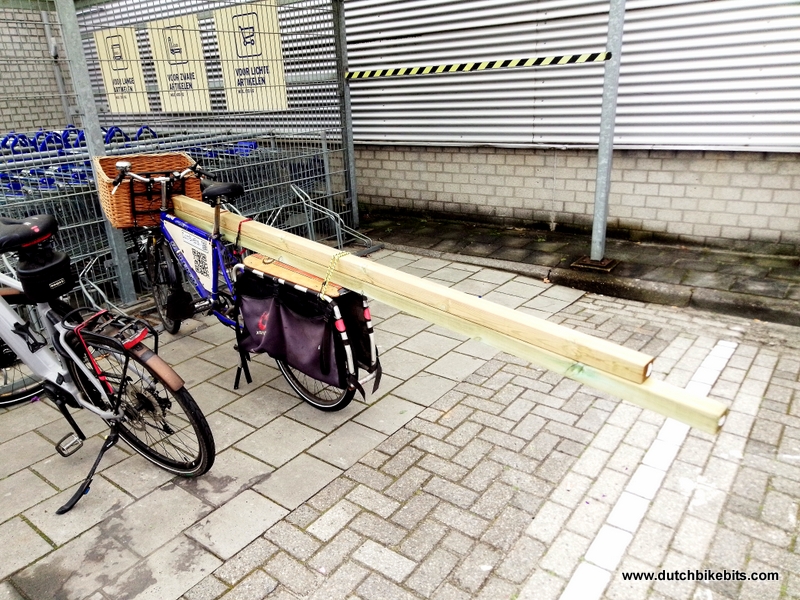
So far as possible I collected the parts required for this job by bike. Three meter long pieces of wood do make for a slightly unusual sight on the cycle-path.

In total the bill for the two new panels, all the parts required to make the brackets and all the parts required to make a safe connection to our electricity supply added up to about €550.

Helping a friend with his installation a few days ago. He then helped me today. Doing things for each other certainly helps to keep costs down !

We now should have enough energy

Our gas supply was removed last week so we need to have a heating solution for next winter which does not involve gas. As discussed a couple of weeks ago, we actually didn't use much gas at all, so replacing it shouldn't require too much electricity. Added to the overproduction of electricity which we already had before they were installed, the new panels ought to be enough to make our net electricity consumption very close to zero for the year.

As it stands right now, our energy company is asking us to pay €5 a month for energy, with an expectation that we will have overpaid by €290 at the end of the year. That seems to be working out quite well !

Over the summer we installed the heating system which the two extra solar panels will supply, a poor man's heatpump. This was too inexpensive to attract a subsidy but it should be enough for us.

Wednesday, 5 April 2023

Eleven years of rooftop solar power - and it's a new record year

Our rooftop solar panels have been in place for eleven years, and the highest output year was the most recent. In total the rooftop panels have delivered 37591 kWh to date.

When we had our rooftop solar panel system installed in April 2012 we were told to expect an output of no more than 3150 kWh per year due to the angle of the panels and the direction they face on our roof. We were also warned that output would drop slowly over time. In practice we actually saw an average of 3357 kWh over the first ten years. Until now the highest output year was the second year after they were installed with 3516 kWh, but that record was broken in this last year, 2022-2023, which is year eleven for our system. No less than 3614 kWh of electricity came from our panels last year, which is nearly 3% more than the previous record.

We actually generated a little more than this because we added a couple of extra panels in September. But because these have only been operating through the darker months until now, they've only added slightly to the total, bringing it to 3780 kWh.

The new peak output wasn't the result of a particularly sunny winter. March, was particularly cold and dark, with snow and hail and produced the third lowest amount of solar power from our roof top panels since they were installed. Luckily, April has brought far more pleasant weather so far.

March 2023 was one of the darkest ever and even the extra panels didn't bring our total for the month to a total which was as high as the average over the ten previous years

The effect of panels facing in different directions

The extra panels on the garage face are installed facing directly south while those on the top of the house face south-west as that's how our house is built. This means that the sun hits the extra panels on the garage earlier than those on top of the house and that we have significantly more solar power earlier in the day now than was the case when we only had the panels on the top of the house.

Proportion of theoretical maximum output achieved by the solar panels on our house roof and those on the garage roof on the day of writing. Having panels facing in different directions flattens out the production curve meaning that we can cover our own usage for a larger proportion of the day.

Early in the morning all our solar panels are in shade, only receiving indirect light. The output of the panels on the garage suddenly come out of the shade of our neighbour's home at about 9:15, giving a rapid rise in output, today seen as a rise from from 5% to 22% of their potential. On the other hand, the panels on the roof of the house don't see a sharp rise due to an obvious shadow, but because of the angle of the roof they don't reach 22% of their potential on the same day until more than an hour later, around 10:30. This difference means that while on a day like this the output of the roof top system alone wouldn't reach 1 kW until nearly 10:45, adding two extra panels on the garage have brought that forward by more than half an hour.

Our garage roof at just after 09:00 this morning. These panels are at a 45 degree angle because that means they face directly toward the south. The sharp shadow line is due to our neighbour's home. The sun has melted the ice off of most of one panel and output is increasing rapidly as the panels receive direct sunlight. When we install two extra panels these two will be pulled back by about half the width of a panel and the two new panels will see the sun slightly earlier each morning than these do.

Doubling the size of the installation on the garage should mean on a day like this we can reach an output level of 1 kW by about 9:45 and 2 kW by just after 10:30. As such, two extra panels will address a source of slight annoyance - ever since the roof top system was installed we've observed that turning on appliances like our washing machine in the morning meant that we drew energy predominantly from the grid instead of from our solar panels, but with four panels facing south on the garage to take up the slack while the larger array on the roof "wakes up" this will no longer be the case - at least in summer.

No more gas so we will probably need more electricity than before

Our gas supply is being removed next week. We've already not used it for some time. In the future we'll probably need a bit more electricity than now so extra capacity is of course helpful.

Effect on a possible future battery installation

If we install a battery in the future, which we are considering in the future, it will have less to do because we will already have improved our autonomy by covering more of our morning electricity usage directly with solar power, thus reducing stress on a battery as it won't have to cover such a large proportion of our energy usage during mornings. I had hoped to have figures for the year so far showing improved autonomy compared with last year, but due to the very dark winter it hasn't been possible to produce those, so that's something for a future blog post.

Tuesday, 21 March 2023

Having the gas disconnected

Having the gas connection removed from a home in the Netherlands costs €869, except that it's subsidized at the moment so costs nothing at all. What better time can there be to remove fossil fuels from your home ? Our gas supply will be cut off in a few weeks time.

It's taken us a bit longer than I'd hoped to get to this point but in a few days our gas supply will finally be cut off. We stopped cooking with gas many years ago, but we still had gas central heating and a gas hot water heater for our shower. It was the latter which stood in the way of getting rid of gas altogether as having no hot water in our bathroom at all, especially over winter, was not at all appealing. However we installed an electric water heater last month which then meant we no longer had a good reason to still have a gas supply to our home.

How much gas, how much CO2 ?
For some odd reason our energy company decided that our annual summary of energy usage should be over a period of February 23rd 2022 to March 11th 2023 this year. That's two weeks longer than a year and includes more of the cold days. The summary shows that we consumed 540 m3 of gas. That's considered to be quite low, but it's still a lot. 540 m3 of gas emits almost a whole ton of CO2 when it's burnt (multiply cubic metres of gas by a factor of 1.78 to find how many kg of CO2 are produced), and that's something that we really do not want to do.

An absurdly over-sized boiler

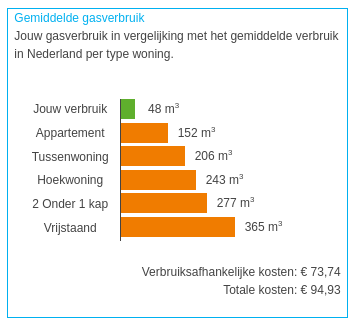
In February we used 48 m3 of gas, about a third of an average
apartment or under a fifth of an average "2 onder 1 kap" (semi-
detached) home similar to ours.
This morning I worked out that the water heater which we removed last month actually accounted for slightly more than half of our total gas consumption for the year. Subtracting the equivalent of 12 summer months (when the central heating is turned completely off) from the entire years gas consumption suggests that only about 245 m3 of gas was used by the central heating boiler last year.

Burning 245 m3 of Dutch gas (at 33.32 MJ/Sm3) releases about 8163 MJ or 2270 kWh of energy. Our gas heating boiler is a Radson EHRE 240 from 1993 with a rated output of 28 kW. It's been obvious for years that it was grossly over-sized - I had to take action a couple of years ago to make it shut down sooner to stop us from getting too hot - but it wasn't until now that I calculated how absurdly powerful it was. A 28 kW output with consumption of 245 m3 of gas suggests that over the whole year this thing only actually operated for the equivalent of about 3 days at full power, spread over the colder five months of the year when we needed heating. i.e. On average it was used for less than half an hour a day.

The beast awaiting removal
Because we put a lot of effort into insulating our home, we can now make our living room and dining room (i.e. most of the ground floor of our home) heat up slowly with nothing more than a 400 W IR electric heater even on very cold days. Clearly we don't need anything like 28 kW !

The boiler dates from before condensing boilers were common-place. Its rated efficiency is 83%. It also doesn't have a balanced flue but instead takes air from the boiler room in which it sits (getting rid of it means we can insulate that room properly and gain a small storage room on the top floor) and as the heated water we receive from it on the ground floor has travelled two floors down to reach our living room and slowly gurgle around the radiators we clearly don't get the benefit of much of the 2270 kWh of energy released by the gas as heat in our living room.

So what now ?
We have decisions to make. Even a few small resistive electric heaters switched on when we're near them would be a more efficient way to hear our home. A friend of ours has reported good results from using an air conditioning unit to heat his living room this winter, and that's definitely more efficient than a resistive heater, but it does make a bit of noise. We will also need some heat upstairs, in the bathroom, bedrooms, work room etc. We've also been working on improving ventilation in our home so fitting a ventilation system with heat exchanger where the old boiler used to sit on the top floor would probably be beneficial. We have decisions to make over the coming months: By December it'll be cold again. 

Hoping to reduce our energy bill further
Last year a quarter of the total gas bill of €1051 was the connection charge. This year our gas bill will be much lower but it won't be zero as we'll still have to pay the connection charge for however long it takes to be disconnected. While gas cost us €1051 last year, our total energy bill for the year was only €587 once we took off the amount that the energy company paid us for nearly 900 kWh of excess electricity that we generated with our solar panels, as well as various other compensations and apparently random things that I've never understood which always appear on energy bills.

Anyway, the energy company decided that we had overpaid by €180 so they're sending us money, which is of course welcome. Then they set our monthly payments this year to be a bit higher than they were last year, which doesn't seem very logical under the circumstances, but they did this last year as well so I'll again have to argue it down this year.

We already added two extra solar panels at the end of last year to roughly cover the water heater's consumption and our plan now is to add a couple more panels again which should leave us with about 1600 kWh per year free compared with last year which we can use for heating. Hopefully that will be about enough. If we end up generating about as much extra electricity as the heating consumes, then not only will we no longer have any fossil fuels in our home but our bills should also be well on the way to zero.

Of course it's impossible to work out exactly what anything will cost because energy bills are absurdly complicated. While we work out how to reduce our energy consumption and CO2 output, perhaps the energy company can put some effort into making their bills understandable.

Job completed earlier than expected


Update 11th April: Our gas supply was removed this morning. Two gentlemen turned up with a digger and made a huge hole in the front garden, removed the supply pipe and the meter from indoors, and then they made everything neat again. So that's it - we no longer have any fossil fuel to burn.

In other news, I took delivery of two more solar panels a couple of days ago. So in a little while I'll write something more about our solar power system.

Over the summer we installed our heating system, a poor man's heatpump. This was too inexpensive to attract a subsidy but it should be enough for us.

Update: Someone was wrong on the internet. Me. So I fixed it.
Somehow I initially made a calculation suggesting that the gas boiler ran for only five minutes last year. This should not have got past my own internal 'smell test'. The boiler actually ran for the equivalent for about three continuous days and the blog above has been updated to reflect this. The other calculations were correct.

Wednesday, 8 February 2023

Electric water heating - finally got rid of the pilot light !

There's nothing much more boring than a photo of a cylindrical water heater hanging on the wall, but there it is boringly getting on with its job, heating the water for our shower and bathroom using solar power from our roof and our showers definitely don't mean burning gas any more !

Over three years have passed since I calculated how much gas the pilot light in our water heating system was consuming. It was a bit frightening. 134 cubic metres a year, That means the pilot light wasted almost twice as much gas each year as we just used for heating our home for the whole of January. What's more, 134 m3 at the current price of around €1.80 per m3 works out as about €240, which due to everything else we've already done to reduce our energy consumption is about half of our total annual energy bill for electric and gas combined (we've paid €40 a month for the last year, and the energy company currently owes us money). It's been at the back of my mind literally since I first made that calculation that I had to do something about it, but there are always other things to do and it took until this week until it happened.

Of course I went through all options, including such things as heat pump water heaters. These appear to only be available in absurdly huge sizes meaning more waste, with costs that are simply too high, and with unknown reliability compared with a simple resistive heater. I also considered complete heating systems including water, but most of the year we unplug our heating system so this seemed less than optimal. Eventually I decided that a simple hot water tank, was the best option so long as it could be well insulated and with some kind of control to stop it wasting energy when we didn't need the hot water.

I should have been able to write this last year. I ordered a water heater in September which got delayed due to covid and then didn't turn up at all. After sitting on a waiting list for several months I eventually asked the company I'd ordered it from for a refund which they sent promptly, so I can't really complain about that. Anyway, I then ordered another type which arrived less than 48 hours after I'd ordered it. It's supposed to be a "DAT Arca 80 litre anti-kalk" (anti calcium) boiler, but for some reason what turned up has "GOT" written on it instead. Before ordering I tried to work out whether I'd be able to buy spare parts, and it seems I can. Not that there's much in this thing to go wrong.

Between the two orders I did a bit of extra research which led me to prioritize buying a boiler with a dry heating element which should last longer.

Smart vs dumb boilers

Some boilers are "smart". The main reason why smart boilers are claimed to use less electricity every year than the boilers with dumb controllers is simply that the dumb boilers are typically switched on 24 hours a day, consuming electricity to make warm water when no-one will use it. Smart boilers include such features as analysing your use for the first week and then only warming water when it thinks you'll need it. That's not a bad idea, but we don't really have a fixed weekly pattern of use so I'd have had to use it as a time switch instead.

At the moment the controller consists of a simple analogue clock style time switch and I've also got an energy meter connected up to let me measure electrical consumption over time.

I have no interest in any "smart" IoT product as connecting things like this to the internet means yet another thing to worry about with potential spyware and software updates (if they happen at all they'll be phased out before the lifespan of the product) so I never had any intention of connecting the boiler to the internet. However the company who made the first product only sold the model of their boilers which had thick insulation alongside the smart controller so that forced the issue. Luckily I found an alternative product that combined 30 mm of polyurethane insulation with a simple dumb thermostat. Perfect for us. I think I would have ended up using the smart controller as nothing more than a time switch anyway, and a cheap analogue time switch for then €5 does the same job.

Matching consumption to available solar power

I also found that some companies were offering "anti-salderings" boilers at extra cost. These come with lower power elements than usual as a better match to domestic solar power installations.

Underneath the easily removed plastic base of the boiler is this mess of wires. Disconnecting the two white wires from the second element halves the energy consumption, making it more compatible with using excess solar power.

The idea of this is to ensure that to the greatest extent possible you only use your own electricity. This is because Dutch energy companies don't give you very much for any extra kWh that you export to the grid, and no-one is quite sure what will happen in the future to the existing rules around this. So when I found it was possible to buy a 1500 W boiler which actually has two 750 W elements wired in parallel, that's what I chose because this can also be run as a 750 W boiler which happens to come with a free spare element. The company that we bought our boiler from also offers an anti-salderings version of the same boiler for €50 more. Does this differ in any way other than only having one element wired up ? I don't know.

Size

The size of the boiler was a topic of much discussion. I'd have been happy with a 30 l boiler, but my wife insisted on 80 l.

The biggest problem with buying a fairly large boiler was the weight. This thing weighs 32 kg. Holding up there above my head over the stairs while Judy helped push it into place to hook it onto the supports that I'd already fitted in the wall took a lot of effort. The bathroom is just behind the wall on the right. This was the closest place to the bathroom where we could install the water heater. This means less loss due to long pipes than was the case with the gas water heater. As you can see, I'd not yet done the plumbing or electrical work when this photo was taken.

I'm almost totally bald while Judy has long hair so it's no surprise that she thought a larger boiler would be necessary. I've done calculations which I think reliably indicate that 50 litres would be more enough for Judy, but as we're grandparents now we might actually need to run a bath for our favourite visitor at some point and that could mean needing more water. The extra large boiler will cost a bit of extra energy, but we can compensate by running it slightly cooler and letting the shower mix in less cold water. But in any case we should have solar power to spare - I expanded the solar installation in September when I ordered the first water boiler specifically in order to cope with this.

Tidying up

The water pipes to the gas heater have been removed but the heater is still in place in the boiler room alongside the central heating boiler (which doesn't get used much, but . I'll get rid of it when the gas central heating boiler is removed, a job which I will probably have to get someone else to do so they can do both at once. Until that day it's doing us no harm and it's perfectly safe - the gas pipe the gas boiler has a tap on it which which is now switched off.

How much energy does it use ?

After three weeks of operation, with us having showers as frequently as usual, the water heater had consumed 44 kWh of electricity. That works out as an expected consumption of about 770 kWh per year to cover all our hot water usage, which would cost about €300 at today's electricity prices. By comparison, the consumption of our old gas water heater's pilot light was 134 m3 per year. At today's price that amount of gas would cost over €400 per year, and remember that that was just for the pilot light. i.e. it didn't include the gas used for actually making hot water that we washed with. So all else being equal, replacing the gas water heater with electric would save us about €10 a month. i.e. it would take about three years before the new water heater has paid for itself in reduced cost.

We expect these extra solar panels installed in September to
generate about the same amount of electricity as the water heater uses
But all else isn't equal: The extra 800 W of additional solar panels which we added to our rooftop system a few months ago should generate approximately the same amount of energy each year as the water heater consumes. As a result, our annual energy cost should just drop by the price of the gas that the water heater burnt, which worked out as about €40 a month. That's quite a significant number for us because €40 a month just happens to be exactly the  same amount as we've paid for our electricity and gas together over the last year.

So as we stand right now our energy bills ought to be very close to zero in future even if we do nothing more to improve efficiency of our home. But that's not the plan. We will of course continue to do more to make our home more efficient, and there will be more blog posts about it.

It's also a battery / storage heater

An instant water heater would consume electricity when it is used. i.e. nighttime showers could not be powered by our solar panels. But with this hot water tank our showers can be powered by our solar panels even if we shower when the sun isn't shining. Another effect of having a tank of hot water heated from solar power during the day to warm our water is that small amount of heat leaking from the water tank is released 24 hours a day. i.e. some of the energy stored by the water heater during the day is released at night, keeping the upstairs of our home slightly warmer in winter.

Why not install solar thermal water heating ?

A perfectly reasonable question, which someone asked on social media. My answer is as follows:

In total the panels, the boiler and all the parts needed to install everything cost less than €1400. It would have cost at least twice as much to install a thermal solar water heater. Also, we'd still have needed to buy the  electric boiler (a more expensive version of it with pipes as well as electric heating) because if we'd gone with solar thermal that would almost certainly not heat the water sufficiently in winter. By doing it this way, all the solar panels on our house & garage combined can contribute to water heating, not just a smaller area so it's likely to work better on darker days.

In addition, the extra solar panels are on the garage roof were easily to reach safely at a low work height while thermal solar panels would have had to be installed on the much higher roof of our home. So in addition to this being a cheaper way of heating water than thermal solar, I also did not have to clamber about on the roof of my house (nor pay anyone to do that dangerous job for me), didn't have to make holes in the roof for pipes which could leak, and there's no risk at all of leakage due to pipes being frozen in winter.

And think of future maintenance. The water heater and solar panels function completely separately from each other. i.e. either can be replaced without affecting the other component of the system.

I don't think that thermal solar makes much sense these days. It did in the past when PV panels were far more expensive than they are now. My father-in-law made his own solar water heating panels in the 1980s. This was an interesting project, they were made of copper sheeting with copper pipes soldered on, all painted black, in an insulated wooden box with glass in front. They were very effective and I enjoyed a few nice warm showers from that system in the summer. But it worked out in large part because they built a home around the system so the panels could be larger than commercial systems and ideally located to work with gravity. Around the same time I was experimenting with my first solar electric panels on my roof, but they produced very little electricity for their size and cost and it would have been completely impractical to use them for heating water. For many years I thought we'd end up with solar thermal water heating, but they were always difficult to install on a standard home, and this is now a better way of doing it.


Anyway, that's another DIY job finished, and we've taken another step in the direction of complete independence from fossil fuel.