Showing posts with label environmentalism. Show all posts

Tuesday, 21 March 2023

Having the gas disconnected

Having the gas connection removed from a home in the Netherlands costs €869, except that it's subsidized at the moment so costs nothing at all. What better time can there be to remove fossil fuels from your home ? Our gas supply will be cut off in a few weeks time.

It's taken us a bit longer than I'd hoped to get to this point but in a few days our gas supply will finally be cut off. We stopped cooking with gas many years ago, but we still had gas central heating and a gas hot water heater for our shower. It was the latter which stood in the way of getting rid of gas altogether as having no hot water in our bathroom at all, especially over winter, was not at all appealing. However we installed an electric water heater last month which then meant we no longer had a good reason to still have a gas supply to our home.

How much gas, how much CO2 ?
For some odd reason our energy company decided that our annual summary of energy usage should be over a period of February 23rd 2022 to March 11th 2023 this year. That's two weeks longer than a year and includes more of the cold days. The summary shows that we consumed 540 m3 of gas. That's considered to be quite low, but it's still a lot. 540 m3 of gas emits almost a whole ton of CO2 when it's burnt (multiply cubic metres of gas by a factor of 1.78 to find how many kg of CO2 are produced), and that's something that we really do not want to do.

An absurdly over-sized boiler
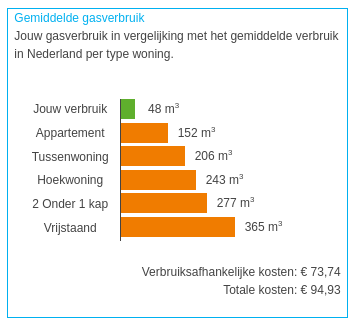
In February we used 48 m3 of gas, about a third of an average
apartment or under a fifth of an average "2 onder 1 kap" (semi-
detached) home similar to ours.
This morning I worked out that the water heater which we removed last month actually accounted for slightly more than half of our total gas consumption for the year. Subtracting the equivalent of 12 summer months (when the central heating is turned completely off) from the entire years gas consumption suggests that only about 245 m3 of gas was used by the central heating boiler last year.

Burning 245 m3 of Dutch gas (at 33.32 MJ/Sm3) releases about 8163 MJ or 2270 kWh of energy. Our gas heating boiler is a Radson EHRE 240 from 1993 with a rated output of 28 kW. It's been obvious for years that it was grossly over-sized - I had to take action a couple of years ago to make it shut down sooner to stop us from getting too hot - but it wasn't until now that I calculated how absurdly powerful it was. A 28 kW output with consumption of 245 m3 of gas suggests that over the whole year this thing only actually operated for the equivalent of about 3 days at full power, spread over the colder five months of the year when we needed heating. i.e. On average it was used for less than half an hour a day.

The beast awaiting removal
Because we put a lot of effort into insulating our home, we can now make our living room and dining room (i.e. most of the ground floor of our home) heat up slowly with nothing more than a 400 W IR electric heater even on very cold days. Clearly we don't need anything like 28 kW !

The boiler dates from before condensing boilers were common-place. Its rated efficiency is 83%. It also doesn't have a balanced flue but instead takes air from the boiler room in which it sits (getting rid of it means we can insulate that room properly and gain a small storage room on the top floor) and as the heated water we receive from it on the ground floor has travelled two floors down to reach our living room and slowly gurgle around the radiators we clearly don't get the benefit of much of the 2270 kWh of energy released by the gas as heat in our living room.

So what now ?
We have decisions to make. Even a few small resistive electric heaters switched on when we're near them would be a more efficient way to hear our home. A friend of ours has reported good results from using an air conditioning unit to heat his living room this winter, and that's definitely more efficient than a resistive heater, but it does make a bit of noise. We will also need some heat upstairs, in the bathroom, bedrooms, work room etc. We've also been working on improving ventilation in our home so fitting a ventilation system with heat exchanger where the old boiler used to sit on the top floor would probably be beneficial. We have decisions to make over the coming months: By December it'll be cold again. 

Hoping to reduce our energy bill further
Last year a quarter of the total gas bill of €1051 was the connection charge. This year our gas bill will be much lower but it won't be zero as we'll still have to pay the connection charge for however long it takes to be disconnected. While gas cost us €1051 last year, our total energy bill for the year was only €587 once we took off the amount that the energy company paid us for nearly 900 kWh of excess electricity that we generated with our solar panels, as well as various other compensations and apparently random things that I've never understood which always appear on energy bills.

Anyway, the energy company decided that we had overpaid by €180 so they're sending us money, which is of course welcome. Then they set our monthly payments this year to be a bit higher than they were last year, which doesn't seem very logical under the circumstances, but they did this last year as well so I'll again have to argue it down this year.

We already added two extra solar panels at the end of last year to roughly cover the water heater's consumption and our plan now is to add a couple more panels again which should leave us with about 1600 kWh per year free compared with last year which we can use for heating. Hopefully that will be about enough. If we end up generating about as much extra electricity as the heating consumes, then not only will we no longer have any fossil fuels in our home but our bills should also be well on the way to zero.

Of course it's impossible to work out exactly what anything will cost because energy bills are absurdly complicated. While we work out how to reduce our energy consumption and CO2 output, perhaps the energy company can put some effort into making their bills understandable.

Job completed earlier than expected


Update 11th April: Our gas supply was removed this morning. Two gentlemen turned up with a digger and made a huge hole in the front garden, removed the supply pipe and the meter from indoors, and then they made everything neat again. So that's it - we no longer have any fossil fuel to burn.

In other news, I took delivery of two more solar panels a couple of days ago. So in a little while I'll write something more about our solar power system.

Over the summer we installed our heating system, a poor man's heatpump. This was too inexpensive to attract a subsidy but it should be enough for us.

Update: Someone was wrong on the internet. Me. So I fixed it.
Somehow I initially made a calculation suggesting that the gas boiler ran for only five minutes last year. This should not have got past my own internal 'smell test'. The boiler actually ran for the equivalent for about three continuous days and the blog above has been updated to reflect this. The other calculations were correct.

Monday, 17 December 2018

Upgrading Windows to version 3 (Continuing to insulate our home with triple glazing)

Our windows were fitted by Van Dijk Services
Assen. They did a good job so deserve a link.
We knew we'd have to do something about the insulation of our home in Assen before we even moved in and every year we've made some change to improve the energy efficiency of our home. One of the oddities of 1970s Dutch homes is that while they had double glazing on the main rooms on the ground floor, it was quite common to have single glazing in places like the hall and all of the bedrooms upstairs. We fixed that problem eight years ago by installing HR++ double glazing to replace all the single glass and this was very effective. But we kept the same older windows downstairs.

It took a while for us to get around to considering the downstairs windows because we were busy with insulating the floor, the roof, the walls, installing solar panels on the roof, our bicycle parts business, and generally getting on with life, but we've now begun. In fact, we did one of the smaller panes last year because the old double glazing had developed a leak and we took this as an opportunity to experiment with triple glazing. We made measurements and found that it was effective. When the outside temperature was -2 C and the inside temperature 17.5 C the temperature of the inside of a double glazed pane was measured as 9 C while the inside of the triple glazed window alongside it measured 14 C. Clearly we could stay warmer with less heating if we replaced more of the old double glazing downstairs in our home with triple glazing.

Thus far we've replaced the glass only on the front of our home. We're still not entirely sure what we'll do on the back of house, but there is less than half the area of double glazing in the living room on the back compared with the front.

One of the old panes being removed

The replacement coming into place. It took some lifting because it weighed 127 kg.

Fixing into place

Just fitted, not made neat and tidy yet.

A tidy job completed. We now have to wait a couple of days before we can clean the glass because the sealant has to dry first.
Travel less, nor more, insulate your home
and don't eat meat
.
We hope this will reduce our gas consumption and our heating bill. We already have a very low energy bill because we generate more electricity than we use. The gas bill, which covers cooking and water heating as well as heating, is also low and has reduced each year. Dutch bills are increasing quite sharply this year due to increased tax on gas, but our estimate for next year is the same as this year, and the energy company doesn't know that we've taken measures which hopefully will reduce our usage further.

It's becoming more and more obvious to us that we can't continue to increase our energy usage but must decrease it. We must decrease our burning of fossil fuels. There is little time left to do this. The IPCC report from the 8th of October told us that emissions need to be reduced to zero in 12 years time. Who is doing enough to make that happen ?

Because of our concerns we are not only continuing to make our home more efficient but have also got rid of our car and stopped our business of offering holidays and study tours. Encouraging people to make international journeys to cycle is just not of this time. We must all stop behaving as if we can do whatever we like without consequences. Our children and our grandchildren, not to mention millions of people in poorer countries, are being made to pay for our own selfishness.

Yesterday afternoon. Four identical houses, ours is on the left. We're winning the race to keep ice on the roof from melting. Luckily it was somewhat warmer today.
January Update: Is it effective ?
We will really only know how effective the triple glazing is after the bills come in and we see if we've used less heating. However it's -4 C in the garden today, the sun is still on the side of the house and the inside of the double glazing at the back measure 8.7 C while the inside of the triple glazing at the front measure 14.5 C. Obviously we are loosing a lot more heat through the double glazed panel than through the single glazed panel.

Ice crystals visible on the outside of a triple glazed window when the temperature is -9 C outside. Photographed from the warmth inside.
There's also a very visible difference in that ice crystals form on the outside the triple glazed panel, proving the temperature there stays below freezing while we have a more liveable temperature inside the house. This never happens with our double glazed windows. In fact the closest thing that I have seen to this in the past was when we had ice all over the inside of the upstairs windows of our house before we replaced the single glazed panels there with double glazing. That wasn't comfortable at all !

Update February 2019 - it's working !
The front of our home, with the living room, is now fully triple glazed while the rear with the dining area (open to the living room) and kitchen remain double glazed. There's now an obvious difference in temperature between the front and the rear which I can also measure. Seeing this graph in February 2019 led me to make a simple calculation of consumption of gas for heating:

Source: Martien Visser.
I keep a spreadsheet of our monthly gas and electric consumption. We used less gas in January 2019 than any other January on record, even the somewhat colder 2017. Our gas consumption in January 2019 was 15% lower than the same month in 2016 when the temperature was very similar. A drop in gas consumption of 15% represents a greater than 15% drop in use of energy for heating because we also use gas for water heating and for cooking.

I only have one month of data so far so have to be cautious, but it appears that the replacement of the front windows with triple glazed panels has been effective. At this rate the windows will have paid for themselves in terms of nothing but a reduced heating bill within ten years even if there is no increase in the price of gas. That's a good rate of return and if it's possible I will replace the rear downstairs windows with triple glazing later this year.

Update November 2019
We've just had the rear windows upgraded to triple glazing.

This time the work was done by D & S Glasmontage, a different local company from the one who did the front windows, but known to us already because they installed new windows for us upstairs many years ago.
So now we're completely triple glazed downstairs except for the window in the back door of the kitchen.

Wednesday, 7 August 2013

Noise from wind turbines. A real problem or NIMBYism ?


Video from a field of 12 turbines which on average provide enough electricity to run about 3700 average homes. The sound is as recorded on the camera at the site. You'll note that we could converse quite normally even right next to a wind turbine.

We can't see any wind turbines from our home because even though there are no hills here to hide them, they're not visible when you're a distance from them. However there are quite a few turbines within range of cycling trips. I've cycled right up to them several times in the past but this time actually made recordings of the noise that their opponents say they produce. You have to listen quite carefully to hear them. It's quite a contrast with with conventional coal-fired power plants and hydro-electric power plants which I've visited in the past, both of which are deafening.

Objections seem to disappear when people have a stake in the turbines. Older two blade turbines like this are less aerodynamically efficient and spin faster (2 blade turbines have to rotate 1.5 times as often as 3 blades to catch the wind) which makes them "noisier" than the newer designs. They're still rather less noisy than milking machinery, though, and this farmer is one of many who has installed such a turbine just a few metres from home.
Yes it's possible to make a recording of the swoosh swoosh sound made by the turbines, but only by increasing the gain and making sure there are no background noises. Any background noise is enough to drown out the turbine noise, including the noise of the wind going through trees or in this case the crunching of gravel beneath my bicycle tyres and the calls of the sheep nearby.

People also live next to really large turbines without really large problems. By contrast, when we lived a few kilometres from a coal fired power station we had dust and often foul smelling air to deal with.
I like wind turbines. They're not a complete solution to our energy needs, but they're a useful part of what we need to do to generate energy in a renewable future. Here in the Netherlands we do not have hydroelectric sources (though we are sometimes sold it as if we do) and due to the flat landscape we have a lot of wind. For this country wind should perhaps appear at a higher point on the alternative energy matrix.

Our holiday route also took us past many traditional windmills. These are of course beautiful, but so are the  modern turbines. They're a symbol of modernity and hope for the future.
I believe that people will come to accept wind turbines once the NIMBYism has been overcome. They're beautiful objects and the worst possible failure mode is simply that one of them should fall apart or fall over. This is in great contrast to the ongoing disaster of global warming due to burning of fossil fuels

One of a series of ludicrous NIMBY "letters to the editor" printed in a pro-nuclear local newspaper in Somerset, UK. Hinkley Point nuclear power station has leaked in the past but not caused an outright disaster. Not yet. Nuclear power has always been claimed to be safe but ask the people of Fukushima perhaps no longer believe it.
Wind power is not efficient on a small scale. Small wind turbines simply don't work very well. It you must install a small scale wind-turbine, the best of them are the larger ones which resemble large scale designs, not the exotic shapes. For domestic installations, solar panels on the roof are a much better idea.

Another farm, another wind turbine. Sensibly, this turbine is installed on land, and the farmer no doubt enjoys watching the electricity meter spin backwards at a considerable speed. Off-shore wind-power is a ridiculous idea by comparison. Maintenance is made far more difficult, running cables to the land is difficult and the salty environment won't do much for the life-span of off-shore turbines.

Tuesday, 30 July 2013

Why I'm not attending Velo-city in Adelaide in 2014. Sorry, I'm not that sort of "environmentalist"

In the last few years I've received several invitations to attend events a long distance from where we live. In the past these included invitations to visit the USA and Brazil. In May I received an invitation to be a keynote speaker at next year's Velo-city conference. I am told that "the conference is expected to attract more than 800 delegates from Australasia, Europe, Asia Pacific and North America" and I'm absolutely certain that it will be interesting for the delegates. However it's impossible for me to square the enormous use of fossil fuels which would be required to transport me half way around the world and back again just to make a presentation lasting a few minutes.

I wrote the following reply to Stephen Yarwood, Lord Mayor of Adelaide, and Michelle Everitt, his Executive Assistant:
Dear Stephen / Michelle,

Thank you for your invitation to attend the Velo-city conference as a keynote speaker in May 2014. I'm very sorry that I've taken so long to get back to you about this, I'm really flattered by the invitation but the reply is difficult to write.

From all that you have written and all that I already know about Adelaide, it looks like a very pleasant place to visit. I am absolutely sure that if I was to visit I would enjoy my stay enormously. However, I am unfortunately not going to be able to come. Given your kindness in inviting me, I owe you an explanation of why:

I try to live my life according to my beliefs and with as little hypocrisy as possible. My cycling advocacy comes from a deeply held belief that cycling is at least a partial solution to many of the problems that human beings currently face. In one stroke, cycling helps to reverse obesity, give children/older people/those with disabilities more freedom, improve air quality in our towns, save lives due to enhancing health and reducing the shocking amount of violent death which occurs on our streets. Cycling also reduces dependency on foreign oil and therefore reduces the number of lives lost in conflict for that oil and, perhaps most important of all, it also reduces the carbon footprint of everyone who chooses to cycle instead of use a vehicle powered by fossil fuels (directly or indirectly) for their journeys.

This is where the problem arises. In order to attend Velo-city in Adelaide I would have to fly a round-trip distance of 32000 km. Making this trip would equate to several times my usual annual impact on the planet simply to make a presentation lasting a few minutes. I cannot possibly square this with my conscience and I must live within my own moral guidelines. I suggest that others don't fly long distances and while it would no doubt be very convenient to excuse my own excess by saying that it's for a higher purpose, I have to apply the same morality to myself as I would to others.

I wish you all the success in the world with improving the cycling modal share of your city and I hope you can learn from the best examples in the world. These are to be found in the Netherlands. There's no other country that comes close. If it would be helpful, I could perhaps record a video exclusively for you to show at the Velo-city conference in lieu of my own attendance in person.

Yours,

David Hembrow.
I have already had the discussion with one email correspondent about how my presentation could cause "100 people to do 1% less driving each" and that this "equals your journey's damage", but I don't buy that. Besides, there's not just one person going, but "more than 800 delegates". I won't be one of them.

It simply does no good for each of us to live beyond our, and our planet's, means. Gandhi once supposedly said that we "must be the change we want to see". Whether it was actually him who said it or not is irrelevant. It still makes sense. If we all live as hypocrites how can we expect to make the world into a better place to leave for our children ?

I urge all readers not to excuse themselves. If you believe that global warming is an issue, don't take unnecessarily long journeys either for leisure or for work. Yes, being offered international travel for free might seem like a lovely perk, but it's not something we should be doing, whoever pays the air-fare. If you believe that such a journey is necessary, consider why you believe that to be the case. The only practical way of reducing your personal energy consumption and your personal footprint on the planet due to travel is to travel less. Switching between modes (i.e. train rather than airliner) helps far less than reducing distances.

We all need to consume fewer resources and we all need to stop treating our own usage as something exceptional and excusable.

Rough comparison of energy consumption of modes of travel from "Instead of Cars" by Terence Bendixon. It's an old reference (1977) but not much has changed. Airliners are now somewhat more efficient than shown here, cars are a little more efficient, other modes much the same as before. The difference between travelling by train vs. aircraft comes down to a factor of about 3. Whatever you do, don't imagine that you do the world any good at all if you travel on a passenger ship instead of by air.
Update May 2014
Nearly a year has passed since I was invited to Velocity. The event is now underway and lots of people from around the world are in attendance. I did not go for the exact reasons explained above. The organisers did not take me up on the offer of sending them a video.

There's one reason why
an oil company wants
to be a "major supporter
of cycling" and that is
to greenwash its image
It was just pointed out to me on twitter that one of the sponsors is an oil company. So I looked at their website, and that's not all that that I found.

I find the whole thing incredibly sad. Many of the eight hundred delegates, including people with titles like "environmental consultant" (this and further links removed because the velocity 2014 website is no longer what it was), have travelled half way across the world, consuming any amount of energy and producing any amount of pollution to do so, merely so that they can talk about the environmentally friendly form of transport called cycling. In many cases they're actually using this to make marketing claims (the usual suspects have been exaggerating). What's more, this is happening at an event which is not only in part sponsored by an oil company but is also has two airlines as "official partners" (so at least three companies are using velocity to give themselves a nice greenwashed image) but which also describes itself as "a sustainable event" seemingly based on taking such minute steps as feeding waste food to a wormery.

It's high time that people started to join the dots together and think about what they are doing, what they are part of, and what their responsibilities ought to be.

Update December 2017
Want to know more ? This year I made a presentation about the environmental effect of travel and wrote a blog post explaining more about the problem. "Green cars" are not going to save us. You may also be interested in my writing about the environment on the other blog.

Saturday, 24 December 2011

It's that ecological footprint time of year...

Today I was pointed towards a website which calculates ecological footprints (link removed because it's no longer what it was). Many people reflect on their life at this time of year, and I suppose that looking at your impact on the planet is a way of reflecting.

The website claims that my carbon footprint is 0.78 earths, which I suppose indicates a relatively sustainable level of consumption.

Being vegan, using motorized transport of all types as little as possible, keeping the thermostat in our home at a relatively low level in winter, not making long distance journeys around the world, making things last and fixing things which go wrong rather than always "updating" equipment all genuinely help to keep the footprint down, and it is likely that our footprint is lower than that of some of our neighbours

Of course, to give an exact figure of "0.78 earths" is actually nonsense. The vagueness of the questions asked means that results are not far from being completely meaningless. Accurately measuring an individual's consumption would take a lot more than a few questions on a website. Besides, like everyone else we consume some amount of fossil fuel both directly and indirectly. There is no truly sustainable level of consumption of a limited resource. What's "ecological" about using up a limited resource, even if we do so relatively frugally ?

I always approach these sorts of things with a bit of caution as you have to ask what the people behind them are trying to achieve. "Follow the money". Sometimes people who take part in such surveys report their calculated impact as something to be proud of, but I don't think they should. Websites are not always what they seem.

In this case, the website is sponsored by a range of different companies including Coca Cola and a construction company whose "Latest News" on their own website concerns a contract for exploitation of oil sands. Do they really have our best interests at heart ? Do they really want us to consume fewer processed foods and less oil or could this be "greenwashing" ?

This website, like others of its ilk, gives "carbon offsetting" as a partial solution. It's nothing of the sort. Carbon offsetting has become a business in its own right. Airlines sometimes give customers an option to "offset" their journeys by paying a little extra when they buy tickets. However, carbon offsetting is a con. It's merely a salve to the conscience. It allows consumers to continue to consume while feeling good about it. However, fundamentally, "offsetting" is a nonsense because it doesn't even attempt to solve the problem that is being created. Buying carbon offsets from an airline does not create more jet fuel. You can't put oil back under the ground by planting a tree.

If you want to do good, then by all means plant trees. Also do please support schemes to give people in the third world more efficient stoves, and make the choice of using renewable energy. These are all good things to do. However, don't imagine that any of these things gives you a right to burn fossil fuels or makes any difference to the impact that you make by doing so.

There is only one way to reduce your impact and that is to reduce how much you consume. Walk or cycle as much as you want, but use motorized transport as little as possible. It's not so much the mode of transport but the distance that you travel which is important. Buy reliable products, look after them and keep them working as long as possible. Don't replace things which still work, don't buy things you don't need. Don't let "fashion" convince you to replace your existing clothes, computer or telephone. Avoid buying products with non-replaceable batteries. Learn to repair things yourself. Insulate your home and keep your thermostat set low in the winter (we only increase ours to 18 C in the evening). Eat responsibly (a vegan diet reduces impact considerably).