Showing posts with label windows. Show all posts

Monday, 17 December 2018

Upgrading Windows to version 3 (Continuing to insulate our home with triple glazing)

Our windows were fitted by Van Dijk Services
Assen. They did a good job so deserve a link.
We knew we'd have to do something about the insulation of our home in Assen before we even moved in and every year we've made some change to improve the energy efficiency of our home. One of the oddities of 1970s Dutch homes is that while they had double glazing on the main rooms on the ground floor, it was quite common to have single glazing in places like the hall and all of the bedrooms upstairs. We fixed that problem eight years ago by installing HR++ double glazing to replace all the single glass and this was very effective. But we kept the same older windows downstairs.

It took a while for us to get around to considering the downstairs windows because we were busy with insulating the floor, the roof, the walls, installing solar panels on the roof, our bicycle parts business, and generally getting on with life, but we've now begun. In fact, we did one of the smaller panes last year because the old double glazing had developed a leak and we took this as an opportunity to experiment with triple glazing. We made measurements and found that it was effective. When the outside temperature was -2 C and the inside temperature 17.5 C the temperature of the inside of a double glazed pane was measured as 9 C while the inside of the triple glazed window alongside it measured 14 C. Clearly we could stay warmer with less heating if we replaced more of the old double glazing downstairs in our home with triple glazing.

Thus far we've replaced the glass only on the front of our home. We're still not entirely sure what we'll do on the back of house, but there is less than half the area of double glazing in the living room on the back compared with the front.

One of the old panes being removed

The replacement coming into place. It took some lifting because it weighed 127 kg.

Fixing into place

Just fitted, not made neat and tidy yet.

A tidy job completed. We now have to wait a couple of days before we can clean the glass because the sealant has to dry first.
Travel less, nor more, insulate your home
and don't eat meat
.
We hope this will reduce our gas consumption and our heating bill. We already have a very low energy bill because we generate more electricity than we use. The gas bill, which covers cooking and water heating as well as heating, is also low and has reduced each year. Dutch bills are increasing quite sharply this year due to increased tax on gas, but our estimate for next year is the same as this year, and the energy company doesn't know that we've taken measures which hopefully will reduce our usage further.

It's becoming more and more obvious to us that we can't continue to increase our energy usage but must decrease it. We must decrease our burning of fossil fuels. There is little time left to do this. The IPCC report from the 8th of October told us that emissions need to be reduced to zero in 12 years time. Who is doing enough to make that happen ?

Because of our concerns we are not only continuing to make our home more efficient but have also got rid of our car and stopped our business of offering holidays and study tours. Encouraging people to make international journeys to cycle is just not of this time. We must all stop behaving as if we can do whatever we like without consequences. Our children and our grandchildren, not to mention millions of people in poorer countries, are being made to pay for our own selfishness.

Yesterday afternoon. Four identical houses, ours is on the left. We're winning the race to keep ice on the roof from melting. Luckily it was somewhat warmer today.
January Update: Is it effective ?
We will really only know how effective the triple glazing is after the bills come in and we see if we've used less heating. However it's -4 C in the garden today, the sun is still on the side of the house and the inside of the double glazing at the back measure 8.7 C while the inside of the triple glazing at the front measure 14.5 C. Obviously we are loosing a lot more heat through the double glazed panel than through the single glazed panel.

Ice crystals visible on the outside of a triple glazed window when the temperature is -9 C outside. Photographed from the warmth inside.
There's also a very visible difference in that ice crystals form on the outside the triple glazed panel, proving the temperature there stays below freezing while we have a more liveable temperature inside the house. This never happens with our double glazed windows. In fact the closest thing that I have seen to this in the past was when we had ice all over the inside of the upstairs windows of our house before we replaced the single glazed panels there with double glazing. That wasn't comfortable at all !

Update February 2019 - it's working !
The front of our home, with the living room, is now fully triple glazed while the rear with the dining area (open to the living room) and kitchen remain double glazed. There's now an obvious difference in temperature between the front and the rear which I can also measure. Seeing this graph in February 2019 led me to make a simple calculation of consumption of gas for heating:

Source: Martien Visser.
I keep a spreadsheet of our monthly gas and electric consumption. We used less gas in January 2019 than any other January on record, even the somewhat colder 2017. Our gas consumption in January 2019 was 15% lower than the same month in 2016 when the temperature was very similar. A drop in gas consumption of 15% represents a greater than 15% drop in use of energy for heating because we also use gas for water heating and for cooking.

I only have one month of data so far so have to be cautious, but it appears that the replacement of the front windows with triple glazed panels has been effective. At this rate the windows will have paid for themselves in terms of nothing but a reduced heating bill within ten years even if there is no increase in the price of gas. That's a good rate of return and if it's possible I will replace the rear downstairs windows with triple glazing later this year.

Update November 2019
We've just had the rear windows upgraded to triple glazing.

This time the work was done by D & S Glasmontage, a different local company from the one who did the front windows, but known to us already because they installed new windows for us upstairs many years ago.
So now we're completely triple glazed downstairs except for the window in the back door of the kitchen.

Wednesday, 13 December 2017

More insulation for our walls and roof

When we first moved into our home in Assen we were disappointed by the lack of insulation resulting in a high energy bill even with low indoor temperatures during our first winter.

We have now lived here for more than ten years. Each year we've done something which has improved the energy efficiency of our home, including this year when we inexpensively added more insulation to the top floor of our home. The result is that this winter our home is again a little warmer and also more energy efficient so more economical than it was before.

Two days of snow followed by warmer weather and rain and
we still have solid snow on our roof. The area under the red
square is where we made the most recent change. The area to
the left of the red square is a bedroom which we had already
insulated in a similar way a few years ago.
The roof
This year's improvement was quite minor: We added insulation to the ceiling above the top floor landing and staircase. This results in the first floor landing and ground floor entrance hall being better insulated than they were before. This job actually began in the first winter that we lived here when I quickly added some thin insulation panels to this area after seeing our first winter fuel bill. It continued a few years later when I doubled the thickness of that insulation but then remained as an unfinished job until the beginning of this year when we began the last part of it, stretched out over months because of other commitments, beginning by adding yet more insulation to reach a total thickness of about 10 cm, covering this with reflective and damp proof foil and finally hiding that with plasterboard (aka gipsplaten, gypsum board, sheetrock), sealant to fill the gaps and applying some paint. Actually, the job is still not quite finished. I need to paint again.

Anyway the process was simple and can be summed up in one photo:
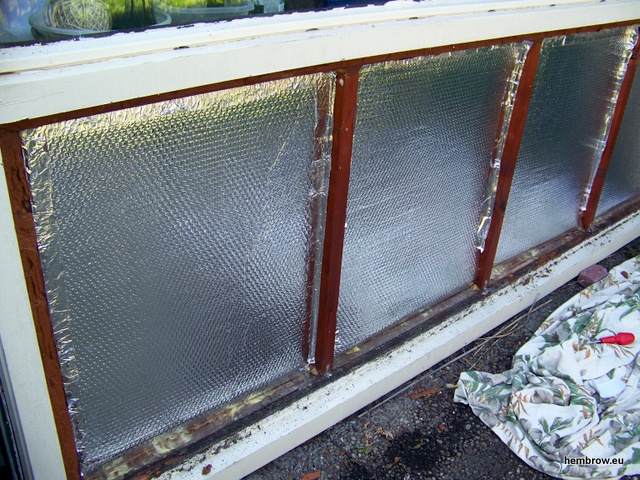
10 cm of solid insulation above double sided bubble wrap foil which itself offers quite good insulation and reflects back energy otherwise lost due to radiation. Gaps in the foil are closed by reflective tape where there are joins. Wooden battens are installed to support the weight of the plasterboard sheets. It's quite important that there is an airtight seal as this prevents condensation from forming behind the insulation where it is cooler.
Also the walls
It's been five years since I last wrote about insulating our home but that's not five years of doing nothing. Another job which was completed a couple of years ago was taking apart the lower parts of the front and back walls on the ground floor of our home. I had long suspected that there was not much insulation inside these walls, and was pleasantly surprised to find that they were better constructed than I had expected. In total there was 4 cm of glass wool plus another 3 cm of polystyrene solid insulation bonded to an asbestos sheet which provides weather protection on the outside of the house to a height of about half a metre (we don't have any other asbestos so far as I know, except a fireproof panel on the door to the room with the central heating).

The existing fibreglass looked a bit sad, clearly it had been damp at some time, though there was no sign of any damage to the wood, all of which looks brand-new from the inside despite being 40 years old. The insulation was not very evenly distributed. I removed it and it was possible to see some gaps through which air could come from inside the house, the probably source of the damp which had discoloured the fibreglass. I sealed the gaps and all around the edges so that the wall is now both air and water tight and no further damage should be possible.

I then used the same double sided reflective bubble plastic here. It's the same double sided bubble wrap type foil as I later used in the ceilings upstairs. In this instance you can see it installed on the inside edge. On top of this I installed the existing fibreglass a bit more evenly than before. It had been discoloured but there was nothing wrong with it. On top of that there is now then another layer of reflective foil which helps to reflect out sunlight in the summer. There is a radiator mounted on the other side of this wall. The interior reflective material is intended to help to keep radiated heat inside the house.

Afterwards I re-installed the original polystyrene + asbestos outside panels, slightly further out than before because the thickness of the reflective foil has added slightly to the overall thickness of the wall. The asbestos is something I intend to dispose of in due course, but covered in paint and on the outside of the house it's not really a danger so for now it will remain until we think of a better alternative. Note the paintwork behind - one of the other problems with these sheets is that paint other than the original brown of the house seems to peel of its own accord. This has been repainted and now looks a lot better again.
Low cost improvements
Neither of these jobs cost much to do. The results of them are difficult to quantify, but thicker insulation and reflective materials to keep infra red energy within the house ought to be expected to bring improvements. We notice that even on cold nights the wall behind the radiator now feels warm rather than feeling cold so it seems that the reflection within the wall is helping. Even more obvious is that we keep snow or frost on our roof a lot longer than any of our neighbours do. Our immediate neighbour's home, featured in some of our photos because it's closest by, is far from the worst in this regard.

Neither of these two jobs was expensive to do. The materials (reflective foil, insulation, tape, sealant, glue, screws) are cheap. It required a bit of planning and took quite a few hours, but it's a reasonable DIY job.

A less inexpensive job
Last year we also had a problem with one of our windows. The seal had broken on an older double glazed unit in our front room, dating from the 1970s, and we arranged for this to be replaced by a new triple glazed unit:

The old glass looked misted up all the time because moisture was caught between the two panes. This is not a rainy day photo even though it looks like one.

The new triple-glazed HR++ panel before installation. It only covers a small percentage of our total glass area but at least this small percentage will perform far better than before.
With windows, the glass isn't the most expensive thing. Labour for fitting this new glass cost more than the glass itself. However this was not a job which I could have done myself as the glass was heavy and needed to be lifted quite high (it's the longest window at the top in our living room in the photos. This more expensive job simply couldn't be done by myself but we did need to replace the panel anyway so decided to pay the small extra cost for triple glazing over double glazing. Our thinking was this while this won't make a huge difference to our energy consumption nor even to our comfort (getting rid of the misty glass it's more of a cosmetic difference), it will at least make a small positive improvement. I estimate that the downstairs will leak energy about 5% less than before.

Measurements made with an infra-red thermometer show that when the outside temperature is -2 C and the inside temperature of our home is 17.5 C, the inside of the older double glazed panel is 9 C while the inside of the new triple glazed panel alongside is 14 C. Clearly heat loss with be much smaller through the triple glazed panel.

Our current plan is to replace other double glazed units with triple glazing as they fail. When we bought our home there was single glazing upstairs but we had that replaced some years ago.

Better insulation = a more pleasant home
Better insulation means a more comfortable home, less energy consumption, a lower carbon footprint, and lower bills. What's not to like about any of that ? Many effective treatments can be made

A white roof is an energy efficient roof ! This photo was taken later the same day as the photo at the top, after a little rain and slightly higher outside temperatures. All four homes originally had identical insulation but our home, the left-most of the four, benefits in quite an obvious way from the extra insulation we've added.

Tuesday, 19 October 2010

New glass

One of the oddities of our home in the Netherlands is that while the ground floor was almost entirely double-glazed, the first floor was not. This was apparently the building standard of the time it was built - 1972.

The windows are large in our house, so they're more important than they might be in a house with smaller windows. However, the rooms without double glazing are those upstairs which we don't really need to keep particularly warm.

For some time we've been weighing up the pros and cons of spending money on glazing for rooms which don't necessarily need to be kept at a particularly high temperature, and eventually made the decision to go ahead with the work.

We were influenced more than a little by a study about the effectiveness of HR++ glazing which gives some figures suggesting that the HR++ glass is particularly effective. Also, the cost was more reasonable than expected (the second company we asked have a quote which was less than half that of the first), and as it was possible to replace the glass within the same hardwood window frames and not have to replace the frames as well (we're not huge fans of PVC windows), we decided it was a good idea.

We don't expect it to make the same big difference to our heating bill as cavity wall insulation did, as the thermostat in the house is downstairs and relatively unaffected by the temperature upstairs. However, it will presumably mean the entire house is better insulated so have some effect on the ground floor as well, and of course it also means the end of condensation on the bedroom windows, which froze on the insides in the winter and made it difficult to open the windows.

Yesterday it happened. New glass in the first floor windows.

We're hoping this makes conditions a little more pleasant for our teenage daughter in the front bedroom, which due to receiving least sunlight was the coldest room in the house in the winter.

So far, our heating bills have been lower each successive winter since we've lived here, as each time the house is a little better insulated than the previous winter. It's a pattern I'd like to continue.