Monday, 17 April 2023

More more solar panels. Do we now have enough energy for a gas free home?

We now have four solar panels on our garage roof. They're at an angle so that they face exactly toward the south.

Today with help from a friend we installed two more solar panels on our garage roof. This means we have four 400 W panels on the garage roof to work alongside the sixteen 235 W panels which are on the roof of our home.

The original two garage mounted panels were in the shade until about 9 am so you can see from this graph that they suddenly "wake up" at that time. The new panels placed today do better a few minutes earlier as they'll be earlier out of the shade.

The roof of our home is oriented south west, while the panels on the garage are oriented directly toward the south so as discussed a few days ago they compliment each other. The garage is shaded by our neighbour's home early in the morning but as the new panels are further to the south and will be shaded less (even though to arrange this we had to push the older pair slightly further north) we're hoping that we see a little bit more electricity early in the morning than was previously the case.

The new set of panels, closer to the camera, are mounted at just 12 degrees, vs. the 24 degrees of the set which we put up last year. This will mean they have slightly lower output overall, but they will shade the older set behind them less often due to being lower at the back and they will catch the morning sun from the east a bit better due to their lower angle creating less of a self-shadow.
The usual "back of an envelope" design process

Last time I couldn't get commercially made hooks as everything seemed to be sold out everywhere. This time I used commercially made hooks to hold the solar panels in place as they were available inexpensively. Otherwise the frame which these panels are mounted on is very similar to that of the last pair of solar panels except that they're at 12 degrees from horizontal this time instead of 24 degrees. This is to decrease the chance of the new set of panels putting the slightly older set behind them in shade and to hopefully increase their output early in the morning when the sun comes from the east. We'll see if that works out.

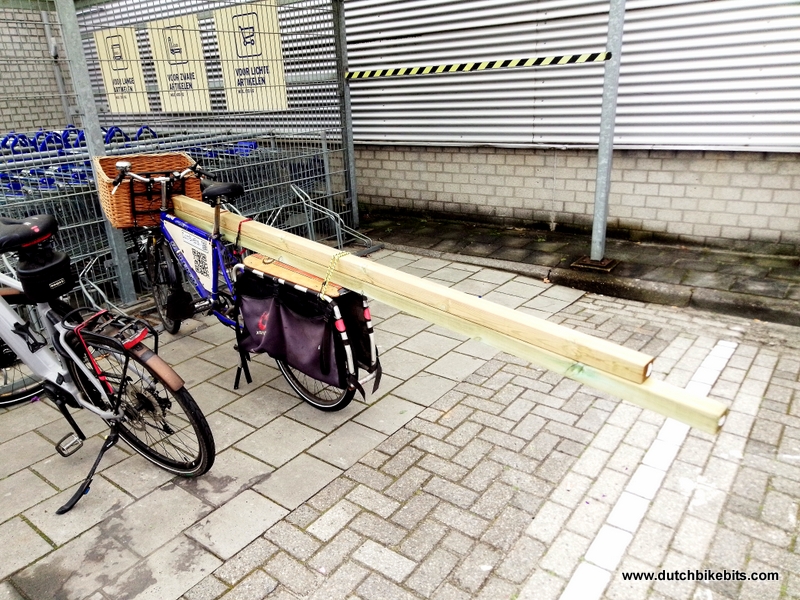
So far as possible I collected the parts required for this job by bike. Three meter long pieces of wood do make for a slightly unusual sight on the cycle-path.

In total the bill for the two new panels, all the parts required to make the brackets and all the parts required to make a safe connection to our electricity supply added up to about €550.

Helping a friend with his installation a few days ago. He then helped me today. Doing things for each other certainly helps to keep costs down !

We now should have enough energy

Our gas supply was removed last week so we need to have a heating solution for next winter which does not involve gas. As discussed a couple of weeks ago, we actually didn't use much gas at all, so replacing it shouldn't require too much electricity. Added to the overproduction of electricity which we already had before they were installed, the new panels ought to be enough to make our net electricity consumption very close to zero for the year.

As it stands right now, our energy company is asking us to pay €5 a month for energy, with an expectation that we will have overpaid by €290 at the end of the year. That seems to be working out quite well !

Over the summer we installed the heating system which the two extra solar panels will supply, a poor man's heatpump. This was too inexpensive to attract a subsidy but it should be enough for us.

Wednesday, 5 April 2023

Eleven years of rooftop solar power - and it's a new record year

Our rooftop solar panels have been in place for eleven years, and the highest output year was the most recent. In total the rooftop panels have delivered 37591 kWh to date.

When we had our rooftop solar panel system installed in April 2012 we were told to expect an output of no more than 3150 kWh per year due to the angle of the panels and the direction they face on our roof. We were also warned that output would drop slowly over time. In practice we actually saw an average of 3357 kWh over the first ten years. Until now the highest output year was the second year after they were installed with 3516 kWh, but that record was broken in this last year, 2022-2023, which is year eleven for our system. No less than 3614 kWh of electricity came from our panels last year, which is nearly 3% more than the previous record.

We actually generated a little more than this because we added a couple of extra panels in September. But because these have only been operating through the darker months until now, they've only added slightly to the total, bringing it to 3780 kWh.

The new peak output wasn't the result of a particularly sunny winter. March, was particularly cold and dark, with snow and hail and produced the third lowest amount of solar power from our roof top panels since they were installed. Luckily, April has brought far more pleasant weather so far.

March 2023 was one of the darkest ever and even the extra panels didn't bring our total for the month to a total which was as high as the average over the ten previous years

The effect of panels facing in different directions

The extra panels on the garage face are installed facing directly south while those on the top of the house face south-west as that's how our house is built. This means that the sun hits the extra panels on the garage earlier than those on top of the house and that we have significantly more solar power earlier in the day now than was the case when we only had the panels on the top of the house.

Proportion of theoretical maximum output achieved by the solar panels on our house roof and those on the garage roof on the day of writing. Having panels facing in different directions flattens out the production curve meaning that we can cover our own usage for a larger proportion of the day.

Early in the morning all our solar panels are in shade, only receiving indirect light. The output of the panels on the garage suddenly come out of the shade of our neighbour's home at about 9:15, giving a rapid rise in output, today seen as a rise from from 5% to 22% of their potential. On the other hand, the panels on the roof of the house don't see a sharp rise due to an obvious shadow, but because of the angle of the roof they don't reach 22% of their potential on the same day until more than an hour later, around 10:30. This difference means that while on a day like this the output of the roof top system alone wouldn't reach 1 kW until nearly 10:45, adding two extra panels on the garage have brought that forward by more than half an hour.

Our garage roof at just after 09:00 this morning. These panels are at a 45 degree angle because that means they face directly toward the south. The sharp shadow line is due to our neighbour's home. The sun has melted the ice off of most of one panel and output is increasing rapidly as the panels receive direct sunlight. When we install two extra panels these two will be pulled back by about half the width of a panel and the two new panels will see the sun slightly earlier each morning than these do.

Doubling the size of the installation on the garage should mean on a day like this we can reach an output level of 1 kW by about 9:45 and 2 kW by just after 10:30. As such, two extra panels will address a source of slight annoyance - ever since the roof top system was installed we've observed that turning on appliances like our washing machine in the morning meant that we drew energy predominantly from the grid instead of from our solar panels, but with four panels facing south on the garage to take up the slack while the larger array on the roof "wakes up" this will no longer be the case - at least in summer.

No more gas so we will probably need more electricity than before

Our gas supply is being removed next week. We've already not used it for some time. In the future we'll probably need a bit more electricity than now so extra capacity is of course helpful.

Effect on a possible future battery installation

If we install a battery in the future, which we are considering in the future, it will have less to do because we will already have improved our autonomy by covering more of our morning electricity usage directly with solar power, thus reducing stress on a battery as it won't have to cover such a large proportion of our energy usage during mornings. I had hoped to have figures for the year so far showing improved autonomy compared with last year, but due to the very dark winter it hasn't been possible to produce those, so that's something for a future blog post.

Tuesday, 21 March 2023

Having the gas disconnected

Having the gas connection removed from a home in the Netherlands costs €869, except that it's subsidized at the moment so costs nothing at all. What better time can there be to remove fossil fuels from your home ? Our gas supply will be cut off in a few weeks time.

It's taken us a bit longer than I'd hoped to get to this point but in a few days our gas supply will finally be cut off. We stopped cooking with gas many years ago, but we still had gas central heating and a gas hot water heater for our shower. It was the latter which stood in the way of getting rid of gas altogether as having no hot water in our bathroom at all, especially over winter, was not at all appealing. However we installed an electric water heater last month which then meant we no longer had a good reason to still have a gas supply to our home.

How much gas, how much CO2 ?
For some odd reason our energy company decided that our annual summary of energy usage should be over a period of February 23rd 2022 to March 11th 2023 this year. That's two weeks longer than a year and includes more of the cold days. The summary shows that we consumed 540 m3 of gas. That's considered to be quite low, but it's still a lot. 540 m3 of gas emits almost a whole ton of CO2 when it's burnt (multiply cubic metres of gas by a factor of 1.78 to find how many kg of CO2 are produced), and that's something that we really do not want to do.

An absurdly over-sized boiler

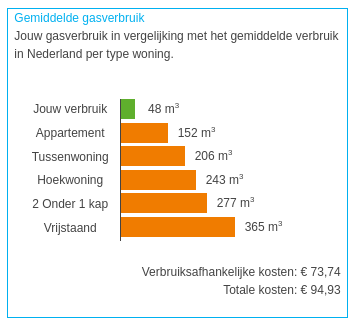
In February we used 48 m3 of gas, about a third of an average
apartment or under a fifth of an average "2 onder 1 kap" (semi-
detached) home similar to ours.
This morning I worked out that the water heater which we removed last month actually accounted for slightly more than half of our total gas consumption for the year. Subtracting the equivalent of 12 summer months (when the central heating is turned completely off) from the entire years gas consumption suggests that only about 245 m3 of gas was used by the central heating boiler last year.

Burning 245 m3 of Dutch gas (at 33.32 MJ/Sm3) releases about 8163 MJ or 2270 kWh of energy. Our gas heating boiler is a Radson EHRE 240 from 1993 with a rated output of 28 kW. It's been obvious for years that it was grossly over-sized - I had to take action a couple of years ago to make it shut down sooner to stop us from getting too hot - but it wasn't until now that I calculated how absurdly powerful it was. A 28 kW output with consumption of 245 m3 of gas suggests that over the whole year this thing only actually operated for the equivalent of about 3 days at full power, spread over the colder five months of the year when we needed heating. i.e. On average it was used for less than half an hour a day.

The beast awaiting removal
Because we put a lot of effort into insulating our home, we can now make our living room and dining room (i.e. most of the ground floor of our home) heat up slowly with nothing more than a 400 W IR electric heater even on very cold days. Clearly we don't need anything like 28 kW !

The boiler dates from before condensing boilers were common-place. Its rated efficiency is 83%. It also doesn't have a balanced flue but instead takes air from the boiler room in which it sits (getting rid of it means we can insulate that room properly and gain a small storage room on the top floor) and as the heated water we receive from it on the ground floor has travelled two floors down to reach our living room and slowly gurgle around the radiators we clearly don't get the benefit of much of the 2270 kWh of energy released by the gas as heat in our living room.

So what now ?
We have decisions to make. Even a few small resistive electric heaters switched on when we're near them would be a more efficient way to hear our home. A friend of ours has reported good results from using an air conditioning unit to heat his living room this winter, and that's definitely more efficient than a resistive heater, but it does make a bit of noise. We will also need some heat upstairs, in the bathroom, bedrooms, work room etc. We've also been working on improving ventilation in our home so fitting a ventilation system with heat exchanger where the old boiler used to sit on the top floor would probably be beneficial. We have decisions to make over the coming months: By December it'll be cold again. 

Hoping to reduce our energy bill further
Last year a quarter of the total gas bill of €1051 was the connection charge. This year our gas bill will be much lower but it won't be zero as we'll still have to pay the connection charge for however long it takes to be disconnected. While gas cost us €1051 last year, our total energy bill for the year was only €587 once we took off the amount that the energy company paid us for nearly 900 kWh of excess electricity that we generated with our solar panels, as well as various other compensations and apparently random things that I've never understood which always appear on energy bills.

Anyway, the energy company decided that we had overpaid by €180 so they're sending us money, which is of course welcome. Then they set our monthly payments this year to be a bit higher than they were last year, which doesn't seem very logical under the circumstances, but they did this last year as well so I'll again have to argue it down this year.

We already added two extra solar panels at the end of last year to roughly cover the water heater's consumption and our plan now is to add a couple more panels again which should leave us with about 1600 kWh per year free compared with last year which we can use for heating. Hopefully that will be about enough. If we end up generating about as much extra electricity as the heating consumes, then not only will we no longer have any fossil fuels in our home but our bills should also be well on the way to zero.

Of course it's impossible to work out exactly what anything will cost because energy bills are absurdly complicated. While we work out how to reduce our energy consumption and CO2 output, perhaps the energy company can put some effort into making their bills understandable.

Job completed earlier than expected


Update 11th April: Our gas supply was removed this morning. Two gentlemen turned up with a digger and made a huge hole in the front garden, removed the supply pipe and the meter from indoors, and then they made everything neat again. So that's it - we no longer have any fossil fuel to burn.

In other news, I took delivery of two more solar panels a couple of days ago. So in a little while I'll write something more about our solar power system.

Over the summer we installed our heating system, a poor man's heatpump. This was too inexpensive to attract a subsidy but it should be enough for us.

Update: Someone was wrong on the internet. Me. So I fixed it.
Somehow I initially made a calculation suggesting that the gas boiler ran for only five minutes last year. This should not have got past my own internal 'smell test'. The boiler actually ran for the equivalent for about three continuous days and the blog above has been updated to reflect this. The other calculations were correct.

Wednesday, 8 February 2023

Electric water heating - finally got rid of the pilot light !

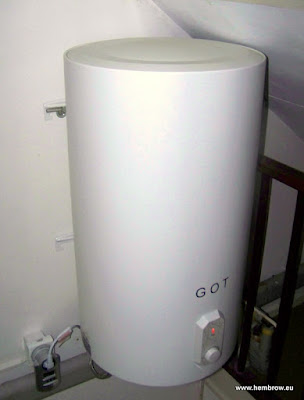
There's nothing much more boring than a photo of a cylindrical water heater hanging on the wall, but there it is boringly getting on with its job, heating the water for our shower and bathroom using solar power from our roof and our showers definitely don't mean burning gas any more !

Over three years have passed since I calculated how much gas the pilot light in our water heating system was consuming. It was a bit frightening. 134 cubic metres a year, That means the pilot light wasted almost twice as much gas each year as we just used for heating our home for the whole of January. What's more, 134 m3 at the current price of around €1.80 per m3 works out as about €240, which due to everything else we've already done to reduce our energy consumption is about half of our total annual energy bill for electric and gas combined (we've paid €40 a month for the last year, and the energy company currently owes us money). It's been at the back of my mind literally since I first made that calculation that I had to do something about it, but there are always other things to do and it took until this week until it happened.

Of course I went through all options, including such things as heat pump water heaters. These appear to only be available in absurdly huge sizes meaning more waste, with costs that are simply too high, and with unknown reliability compared with a simple resistive heater. I also considered complete heating systems including water, but most of the year we unplug our heating system so this seemed less than optimal. Eventually I decided that a simple hot water tank, was the best option so long as it could be well insulated and with some kind of control to stop it wasting energy when we didn't need the hot water.

I should have been able to write this last year. I ordered a water heater in September which got delayed due to covid and then didn't turn up at all. After sitting on a waiting list for several months I eventually asked the company I'd ordered it from for a refund which they sent promptly, so I can't really complain about that. Anyway, I then ordered another type which arrived less than 48 hours after I'd ordered it. It's supposed to be a "DAT Arca 80 litre anti-kalk" (anti calcium) boiler, but for some reason what turned up has "GOT" written on it instead. Before ordering I tried to work out whether I'd be able to buy spare parts, and it seems I can. Not that there's much in this thing to go wrong.

Between the two orders I did a bit of extra research which led me to prioritize buying a boiler with a dry heating element which should last longer.

Smart vs dumb boilers

Some boilers are "smart". The main reason why smart boilers are claimed to use less electricity every year than the boilers with dumb controllers is simply that the dumb boilers are typically switched on 24 hours a day, consuming electricity to make warm water when no-one will use it. Smart boilers include such features as analysing your use for the first week and then only warming water when it thinks you'll need it. That's not a bad idea, but we don't really have a fixed weekly pattern of use so I'd have had to use it as a time switch instead.
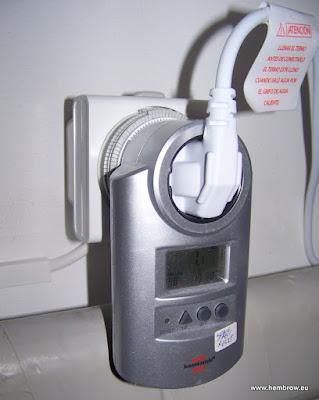
At the moment the controller consists of a simple analogue clock style time switch and I've also got an energy meter connected up to let me measure electrical consumption over time.

I have no interest in any "smart" IoT product as connecting things like this to the internet means yet another thing to worry about with potential spyware and software updates (if they happen at all they'll be phased out before the lifespan of the product) so I never had any intention of connecting the boiler to the internet. However the company who made the first product only sold the model of their boilers which had thick insulation alongside the smart controller so that forced the issue. Luckily I found an alternative product that combined 30 mm of polyurethane insulation with a simple dumb thermostat. Perfect for us. I think I would have ended up using the smart controller as nothing more than a time switch anyway, and a cheap analogue time switch for then €5 does the same job.

Matching consumption to available solar power

I also found that some companies were offering "anti-salderings" boilers at extra cost. These come with lower power elements than usual as a better match to domestic solar power installations.
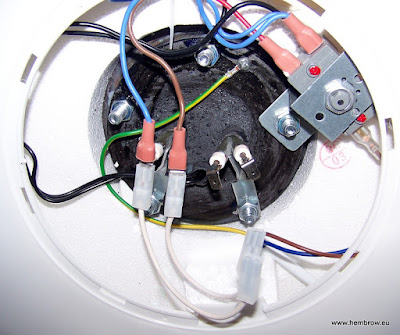
Underneath the easily removed plastic base of the boiler is this mess of wires. Disconnecting the two white wires from the second element halves the energy consumption, making it more compatible with using excess solar power.

The idea of this is to ensure that to the greatest extent possible you only use your own electricity. This is because Dutch energy companies don't give you very much for any extra kWh that you export to the grid, and no-one is quite sure what will happen in the future to the existing rules around this. So when I found it was possible to buy a 1500 W boiler which actually has two 750 W elements wired in parallel, that's what I chose because this can also be run as a 750 W boiler which happens to come with a free spare element. The company that we bought our boiler from also offers an anti-salderings version of the same boiler for €50 more. Does this differ in any way other than only having one element wired up ? I don't know.

Size

The size of the boiler was a topic of much discussion. I'd have been happy with a 30 l boiler, but my wife insisted on 80 l.
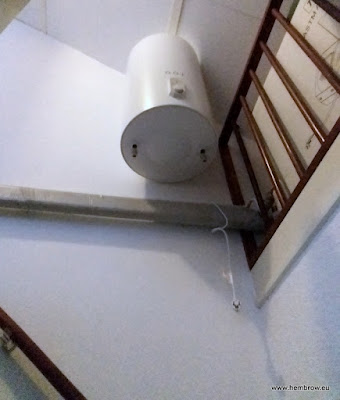
The biggest problem with buying a fairly large boiler was the weight. This thing weighs 32 kg. Holding up there above my head over the stairs while Judy helped push it into place to hook it onto the supports that I'd already fitted in the wall took a lot of effort. The bathroom is just behind the wall on the right. This was the closest place to the bathroom where we could install the water heater. This means less loss due to long pipes than was the case with the gas water heater. As you can see, I'd not yet done the plumbing or electrical work when this photo was taken.

I'm almost totally bald while Judy has long hair so it's no surprise that she thought a larger boiler would be necessary. I've done calculations which I think reliably indicate that 50 litres would be more enough for Judy, but as we're grandparents now we might actually need to run a bath for our favourite visitor at some point and that could mean needing more water. The extra large boiler will cost a bit of extra energy, but we can compensate by running it slightly cooler and letting the shower mix in less cold water. But in any case we should have solar power to spare - I expanded the solar installation in September when I ordered the first water boiler specifically in order to cope with this.

Tidying up

The water pipes to the gas heater have been removed but the heater is still in place in the boiler room alongside the central heating boiler (which doesn't get used much, but . I'll get rid of it when the gas central heating boiler is removed, a job which I will probably have to get someone else to do so they can do both at once. Until that day it's doing us no harm and it's perfectly safe - the gas pipe the gas boiler has a tap on it which which is now switched off.

How much energy does it use ?

After three weeks of operation, with us having showers as frequently as usual, the water heater had consumed 44 kWh of electricity. That works out as an expected consumption of about 770 kWh per year to cover all our hot water usage, which would cost about €300 at today's electricity prices. By comparison, the consumption of our old gas water heater's pilot light was 134 m3 per year. At today's price that amount of gas would cost over €400 per year, and remember that that was just for the pilot light. i.e. it didn't include the gas used for actually making hot water that we washed with. So all else being equal, replacing the gas water heater with electric would save us about €10 a month. i.e. it would take about three years before the new water heater has paid for itself in reduced cost.

We expect these extra solar panels installed in September to
generate about the same amount of electricity as the water heater uses
But all else isn't equal: The extra 800 W of additional solar panels which we added to our rooftop system a few months ago should generate approximately the same amount of energy each year as the water heater consumes. As a result, our annual energy cost should just drop by the price of the gas that the water heater burnt, which worked out as about €40 a month. That's quite a significant number for us because €40 a month just happens to be exactly the  same amount as we've paid for our electricity and gas together over the last year.

So as we stand right now our energy bills ought to be very close to zero in future even if we do nothing more to improve efficiency of our home. But that's not the plan. We will of course continue to do more to make our home more efficient, and there will be more blog posts about it.

It's also a battery / storage heater

An instant water heater would consume electricity when it is used. i.e. nighttime showers could not be powered by our solar panels. But with this hot water tank our showers can be powered by our solar panels even if we shower when the sun isn't shining. Another effect of having a tank of hot water heated from solar power during the day to warm our water is that small amount of heat leaking from the water tank is released 24 hours a day. i.e. some of the energy stored by the water heater during the day is released at night, keeping the upstairs of our home slightly warmer in winter.

Why not install solar thermal water heating ?

A perfectly reasonable question, which someone asked on social media. My answer is as follows:

In total the panels, the boiler and all the parts needed to install everything cost less than €1400. It would have cost at least twice as much to install a thermal solar water heater. Also, we'd still have needed to buy the  electric boiler (a more expensive version of it with pipes as well as electric heating) because if we'd gone with solar thermal that would almost certainly not heat the water sufficiently in winter. By doing it this way, all the solar panels on our house & garage combined can contribute to water heating, not just a smaller area so it's likely to work better on darker days.

In addition, the extra solar panels are on the garage roof were easily to reach safely at a low work height while thermal solar panels would have had to be installed on the much higher roof of our home. So in addition to this being a cheaper way of heating water than thermal solar, I also did not have to clamber about on the roof of my house (nor pay anyone to do that dangerous job for me), didn't have to make holes in the roof for pipes which could leak, and there's no risk at all of leakage due to pipes being frozen in winter.

And think of future maintenance. The water heater and solar panels function completely separately from each other. i.e. either can be replaced without affecting the other component of the system.

I don't think that thermal solar makes much sense these days. It did in the past when PV panels were far more expensive than they are now. My father-in-law made his own solar water heating panels in the 1980s. This was an interesting project, they were made of copper sheeting with copper pipes soldered on, all painted black, in an insulated wooden box with glass in front. They were very effective and I enjoyed a few nice warm showers from that system in the summer. But it worked out in large part because they built a home around the system so the panels could be larger than commercial systems and ideally located to work with gravity. Around the same time I was experimenting with my first solar electric panels on my roof, but they produced very little electricity for their size and cost and it would have been completely impractical to use them for heating water. For many years I thought we'd end up with solar thermal water heating, but they were always difficult to install on a standard home, and this is now a better way of doing it.


Anyway, that's another DIY job finished, and we've taken another step in the direction of complete independence from fossil fuel.

Friday, 9 September 2022

Let's have more solar power

On Wednesday we brought home some solar panels and an inverter and we finished installing them on the roof of our garage today.

These panels are aimed to the south to try to pick up the maximum sun that they can over the whole day, but nearby trees will cause some shading.

We bought this set of parts from a local supplier, Cedel, so that we could pick them up. The panels aren't extremely heavy, at about 18 kg each, but they are large at 1.8 m x 1.1 m each and of course they're made of glass so quite delicate. As a result, this turned out to be one of the very rare jobs which couldn't be done by bicycle but luckily our son-in-law volunteered to drive with a trailer to collect the panels. Cedel sells a set of two 400 Wp panels with a Hoymiles HM-800 micro-inverter for €800, including a plug and play cable which can simply be connected to an electrical outlet, but I paid an extra €50 for an HM-1500 which can run four panels so that we can expand this system economically in the future. An expanded system will require wiring directly to the meter cupboard so that's another thing that I'll had to do if we decide to add those extra panels

Due to supply chain issues, standard mounting parts were not available. However, that's not really a difficult job. A quick bit of SohCahToa remembered from school and some literally back of the envelope calculations allowed me to work out dimensions for the substantial impregnated fence posts which I'd decided to use to construct the supports.

It turned out that when I included the 68 mm width of the posts in the calculation I could make the entire support with wooden parts of 1 m in length for all the horizontal parts and 0.4 m in length for all the vertical parts, dimensions which resulted in the minimum of waste from fence posts of a standard 2.4 m length.

Our garden fence consists of 4 m2 panels each of which is held up by two fence posts of the same type shared with the next panel. i.e. there's about one post per 4 m2. This has stayed intact through every kind of storm for at least 20 years, and the only work I've had to do was to re-enforce a few panels  which gone rotten at the base where they're buried in soil. So I think the same type of wood is certainly strong and resilient enough in much shorter lengths when holding a 2 m2 panel at a 22 degree angle from horizontal.

It's recommended that 22 kg of ballast be used for each panel in our location and at the height of our garage roof. These supports much heavier than the commercial systems, already weighing nearly 20 kg for each panel, and I've added quite a lot of tiles from the garden, each of which weighs about 8 kg so in total including the supports we have about 70 kg of ballast per panel. This should be adequate. Note that while that sounds like a heavy thing to put on the roof, I weigh nearly as much as the ballast and panel combined and when I walk on the garage roof all the weight is concentrated in the area of one of my feet. The solar panels mounted in this way spread their similar weight over about 4 times the area that I do when I walk.

This took about two days to do, including all the measuring, lifting, cutting etc. We were also delayed by rain. It's a fairly easy DIY job. And if the panels generate around 800 kWh per year, then at next year's 60 cent per kWh price it'll take less than two years for them to earn back what they cost.

The parts were ordered last Friday and ready for collection on Monday. It then took me two days to arrange collection and today I finished installing this setup on the roof of our garage. It's almost impossible to get anything done quickly by someone else at the moment due to covid related staff shortages, but if you're willing to do some DIY most things can still be done quite quickly.

That's not all

These aren't our first solar panels. Actually, we had 16 235 Wp panels installed on our roof ten years ago which still operate perfectly.

Our original 16 panels oriented south-west and still working as well as when they were first installed 10 years ago.

When the 16 panels were originally installed we expected that they'd fall a little short of covering our annual consumption of electricity, but actually they turned out to produce more than had been estimated and almost exactly the same amount as we used. Over time, our consumption has dropped quite a lot while production of the panels has stayed exactly the same for ten years, so for the last few years we've exported more electricity to the grid than we have taken from it. The only problem we've had with that system in the last ten years is that the inverter failed four years ago, but even though the manufacturer wasn't co-operative at all I fixed it at minimal cost and it's operated perfectly since then.

So you might wonder why we are now installing more panels. The answer of course is that we want to get rid of all our gas appliances. It's been known for many years that fossil fuels are endangering all life on the planet. This has to stop. We can't control everything, but we can control our own consumption. By continuing to buy fossil fuel we empower the companies that produce it and we just can't keep doing that. Insulating our home has already reduced our gas consumption for heating to less than an average small apartment, and we now cook entirely with electricity (the cooker only ever used a fraction of the gas that heating uses). We didn't replace our central heating boiler, which is old and inefficient, because buying a new boiler would lock us in to continued gas usage. Our low consumption is entirely the result of it not having much to do any more because the house is so well insulated. That means we could now economically replace our gas central heating with electrical heating, and that's even more true as of today with the extra pair of solar panels.

Heat pumps which could replace the central heating and heat the entire house in winter are still quite expensive and a bit hard to justify on price grounds, but we could install a small air conditioning unit which can produce heat with about the same efficiency as a heat pump in the living room as that's relatively inexpensive so that may be what we choose. We barely use any heating in the upstairs anyway.

A third smaller, experimental system

We've also been experimenting with smaller scale solar power system. One of our daughters lives in a flat in Assen. Unfortunately we can't fit solar panels anywhere on the outside. The balcony might have been an option but it faces north west so only receives sun just before sun-down which means it's quite a pleasant place to sit on a summer evening, but doesn't make any sense at all for solar panels. The rear windows face south east, but there's no place outside on that side of the building. As there are no really good options I decided to experiment with mounting solar panels inside the double glazed windows. After all, if you don't try it you don't know how well it works.

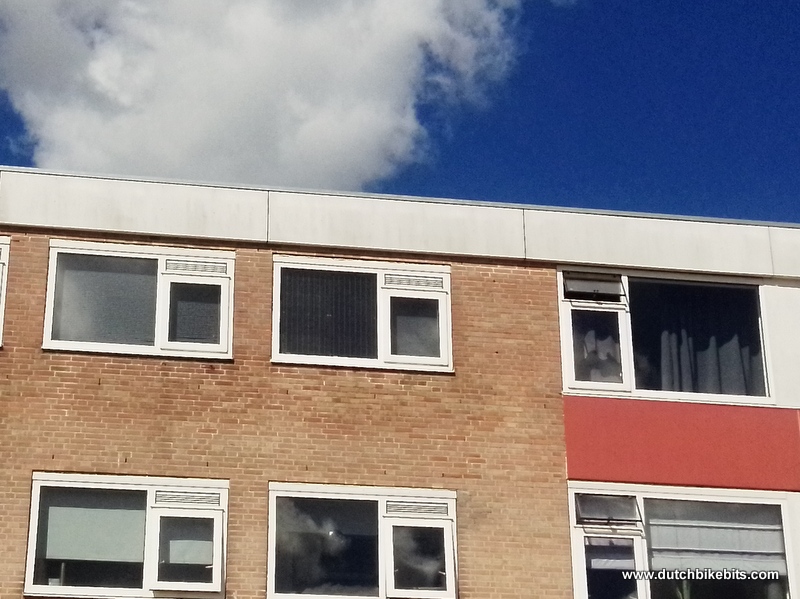
From the outside it's quite difficult to tell which window is full of solar panels.

They're just the right size to fill this window. Luckily there are other windows in this flat so this doesn't block all light.

The panels for the flat are a flexible type ordered from Aliexpress. I couldn't find them anywhere else. Luckily, one supplier has a depot in Poland which because it's inside the EU meant they were delivered to us promptly and without any unpleasant customs related surprises. These panels are a quarter of the size of the new panels that we've installed on the garage, just 1050 mm long by 550 mm wide. They're also really light in weight. As a result they're much easier to transport, I took both of these panels to the flat packed in their cardboard box by riding my bike with the box wedged under one arm. The inverter in this case is a Hoymiles HM-400, which operates quite well with two of these panels connected in series, though as it's rated for 400 W it's working well under maximum capacity.

These panels are nominally rated at 100 W each. Two of them connected in series and propped up in our garden roughly aimed at the sun on the reasonably sunny day when they arrived together produced 140 W, which seems quite reasonable. In the window of the flat we've not yet seen more than 90 W due to losses caused by the glass and the requirement to mount them vertically. Update later in September: we've now seen over 100 W on several occasions from the panels in the flat window. This might make them more worthwhile.

It's still an experiment. We want to help our daughter with the ever rising energy costs, but will this be worth doing given that the output is quite low ? It seems that mounting the panels inside roughly halves their output. This will vary depending on the glass, of course, and also on the panels due to different panels reacting to different frequencies of light. One smaller 12 V / 20 W panel that I have at home loses only about 20% due to being held inside a double glazed window, but unfortunately these panels are affected to a larger degree.

In total this system cost about €360. Half of the price was for the solar panels and the other half for the inverter. In the first week that they were connected, in September, we saw about 0.25 kWh per day from the panels mounted inside the flat. At the end of the year my daughter's electricity will cost over 60 cents per kWh, so that's worth about 15 cents per day. If we estimate that the average over a year is about half that much the electricity generated by these panels will be worth about €27 a year, which means a payback period of over thirteen years which I think is too long by any way of looking at it.

How about if we add two more panels (connected serial/parallel - making the equivalent of one 400 Wp panel which is still within the specs for the HM-400) ? Obviously this would block another window. It would also increase the cost of the system by 50%, but output would increase by 100%, or perhaps even slightly more if the inverter wakes up earlier due to the increased output of four panels. The result is a would be a payback period of almost exactly ten years, if the electricity price stays at 60 cents per kWh, which is still not great, but it's not far off what I originally expected from the roof-top system. Of course if prices continue to rise then the payback period will become shorter, but they may also drop.

For now I don't desperately need these panels for another purpose so they can stay put for a longer experimental period, or until my daughter says she wants rid of them. They'd perhaps be more effectively deployed on the south west facing wall of our home where they'd pick up the early morning light without their output being reduced by being mounted behind glass, and pay for themselves in about 7 years. I think a set of four of these would make a fairly good easily transportable system for someone who lives in a rented apartment and has a south facing balcony as they'd then pay for themselves in about five years.

Another really small system

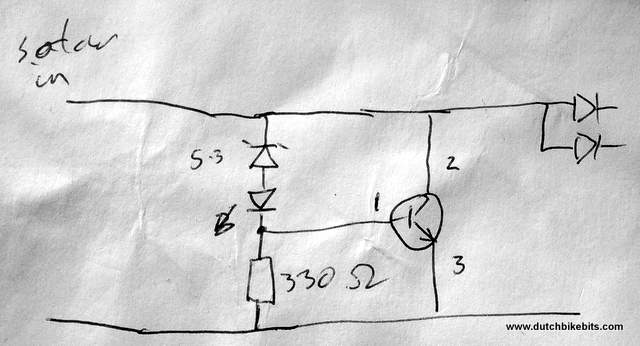
I've had a small flexible solar panel on my velomobile for over ten years. In summer it's kept the battery charged so everyday use didn't require plugging in a charger. Unfortunately, the circuit got damaged and I had to replace it. I decided that this time I'd use a much simpler circuit - a shunt regulator with a zener and a single transistor to limit the voltage to about 7 V. Current is limited by the panel itself, the internal resistance of the battery and because once the voltage gets close to the maximum the shunt starts to conduct a bit. This circuit does a reasonable job of keeping a NiMH battery pack topped up and it can't damage that kind of battery. Don't even think about trying this with a lithium battery. I built two of these so that Judy no longer has to charge the battery for her velomobile either:


Velomobiles are the most efficient vehicles on the planet, maximising the potential of human muscle power. Judy's now has a small solar panel, just like that on my velomobile, which keeps the battery used for lighting and indicators topped up.

Of course I've not even tried to work out whether this is economical compared with charging from the mains. I had the parts and it's convenient for us.

Wednesday, 24 August 2022

Repairing and improving a vacuum cleaner. Samsung SC4580/SC4581 motor replacement and leak fix

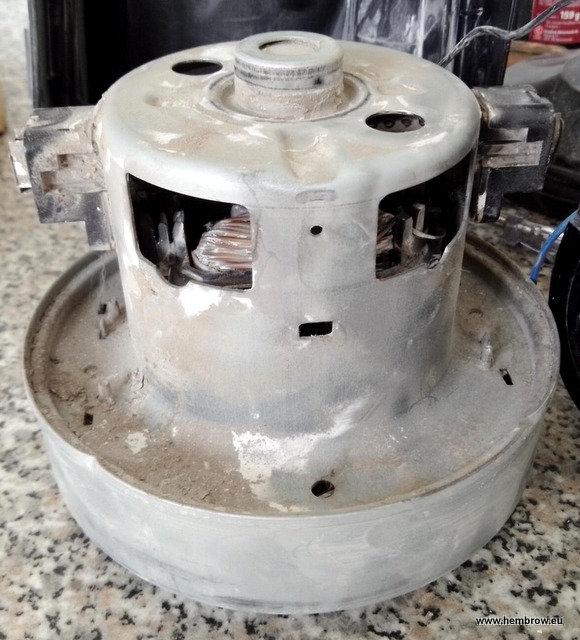
 A few days ago our vacuum cleaner stopped working. What actually happened is that it made a rather unpleasant burning electronics smell, accompanied by a significant reduction in suction. I took it apart, and the first thing that was required was a good clean. Clearly the dust which went into this vacuum cleaner did not all end up being collected, but was instead swirling around all the internal parts because there were so many leaks. So the first thing I did was take everything into the garden for a wash.

By connecting the mains electricity directly to the motor instead of running it through the electronic speed controller I could confirm that it was indeed the motor itself which was faulty. The motor is combined with an impeller and put together without any easily removable fasteners. They are not separable or easily maintainable. The bearing seemed to be fine, but it was obvious that the coils had become rather hot and that the insulation on them was no working properly


A direct replacement motor is available from Samsung, but this costs about €90. On the other hand a generic replacement motor with the same dimensions (130 mm diameter, 110 mm height), described as suitable for Samsung / Dyson / AEG and other makes, cost only €30. So that's what I ordered as a replacement. Note that this suggests that all these vacuum cleaners have essentially the same parts inside apart from the plastic mouldings around the motor.

Label on the generic replacement motor. Little information other than diameter, height and wattage.

The generic motor was the same size, but not identical in all ways. In particular, the two holes on the top of the motor must line up with two plastic studs inside the plastic housing which hold in place a piece of rubber which absorbs shock and stops the motor from rotating:


This, of course could be fixed. I cut off the plastic studs, drilled holes in the correct place for the replacement motor and glued some wooden dowels into place with epoxy:


Another small issue was the power connectors were a different place on the replacement motor and the housing didn't provide space for them. I found that they could be bent slightly to fit and then I had to solder wire directly to the terminals instead of using push-on connectors. The parts could then be re-assembled.

While looking for information about these vacuum cleaners I came across an interesting blog from someone who had eliminated the leaks. While re-assembling I followed his suggestions in the hope that this would improve performance.

Result: Our vacuum cleaner now works perfectly again

It's as good as new. Actually it's better than new in three ways:

  1. It sucks better than ever
  2. It is much quieter than it used to be
  3. It uses uses less electricity than before

The replacement motor is rated at 1200 W instead of the 2000 W originally fitted so power consumption is lower (this obviously depends on the power setting), but it's sucking better because sealing the leaks means that less of the effort put in by the motor is wasted. Meanwhile, getting rid of the leaks also means that most of the wind noise that the machine made has now gone away.

Tuesday, 5 April 2022

Ten years of rooftop solar power - no decline in output can be seen

Today is the tenth anniversary of the installation of our mains connected rooftop solar panels. In total the inverter reports that 33935 kWh of electricity have been generated in ten years, an average of 3394 kWh per year since they were installed.

After ten years we still can't see any decline in output

Output in kWh per year. Note that there's considerable variation depending on the weather. The lowest output was 3126 kWh in 2018-2019 and the highest 3516 kWh in the second year. Last year was also higher than average, within 0.1% of the highest.

A rough calculation before installation suggested that we could expect around 3478 kWh of electricity each year under ideal circumstances, but our supplier suggested that in practice given the angle of our roof we should expect around 3150 kWh per year. The guarantee with the panels said that a decline in performance of 10% over the first 10 years was within normal bounds. This year's 3392 kWh is only slightly under the ten year average, but as it's higher than four of the previous years (including the first year) it's also far from abnormal. I don't see evidence of a decline in output due to aging.

We still produce more electricity than we consume

Blue and red bars show production and consumption per month. The yellow line shows the cumulative difference which we've exported to the grid. We started consuming less electricity five years ago, but over the last year we've consumed slightly more than the previous four years.

I painted our house last year, but I didn't clean
the solar panels. That doesn't seem to matter at all

Over the ten year period we've produced about 10% more electricity than we've consumed, but actually for the first five years our consumption was close to the production (for reasons explained previously) so it's more accurate to say that we've produced about 20% "too much" over the last five years. In other words, our overproduction over five years is roughly the same as the annual consumption of a household like ours.

Cooking with electricity changes the pattern

You'll notice that the graph showing the cumulative difference between our production and consumption has actually leveled off a bit over the last year. The reason for this is that we've switched to cooking with electricity instead of gas, this being one of the ways we've been trying to further reduce the footprint of our already low carbon diet. There's no new kitchen, that'll have to wait for a while. We've been using a small portable electric hob resting on top of the gas appliance as an experiment, which has worked out very well. An induction hob would probably work better. Anyway, it's nice to see that despite this increase in electricity consumption the yellow line is still heading upward at a faster rate than it did on any year before 2016.

Thoughts about home storage

A smart meter was installed four years ago so we now have three full years of smart meter readings. Though we have a single tariff contract so pay the same for electricity any time night or day, the smart meter nevertheless separates out the low and high rates of electricity which roughly correspond to day and night. Overall through the year, 39% of the electricity that we use comes directly from our own panels while 61% comes from the grid and we use 38% of what is generated by our panels while exporting 62%. Obviously a battery comes to mind immediately when looking at these figures, but I'm still not convinced that it's worth the investment. How much could it change these figures ? I think by less than we might hope:

Home storage batteries have capacities of around half of a day to a whole day of typical usage. It's enough to reliably keep your refrigerator going overnight during summer, but not remotely enough to span the seasons.

In the summer months such a battery would fill up in the first couple of days and then it would stay nearly full for weeks. The battery would allow us to consume our own electricity overnight, so that for periods of nice weather all of the electricity we use would be "our" electricity from our panels, which is of course an attractive idea. During that best case scenario we would increase from the average 60% of our electricity that currently comes from our own panels during summer to 100%. For the six best months each year we produce on average between 1.7x and 2.1x as much electricity as we consume so even with a battery working as well as it possibly could we could still only capture some of our own electricity for our usage and doing this would only actually increase the percentage of our own electricity that we consumed from the current still 30-35%% to about 50-60%. Also, this is Northern Europe. There are periods even during the nicest Northern European summers when the solar panels don't produce as much as we'd like, so the battery will run down and we would still have to buy some of our electricity from the grid.

New, huge, windturbine in Drenthe
And then there's winter: In the winter months there's far less sunlight falling on our panels and we possibly produce enough electricity to cover our own usage without annexing our neighbours' roofs. Because there's so little sun in the winter what comes from our panels currently covers only about 10-15% of our consumption and during these dark months that means we are already consuming 70-80% of our own electricity just with normal daytime usage. During the winter a battery would therefore be empty or near empty most of the time. While a battery would mean we would reliably consume all of our "own" electricity during winter it wouldn't win us much because there's not much to store: It would reduce the proportion of our electricity that we buy from the grid from the approximately 90% during winter now to around 85% with a battery.

Financially I don't see the benefit of a battery at all. It's an expensive gadget which will change very little. Let's also remember that the electricity leaving our home is not wasted. It's used elsewhere, reducing demand for other, on average less green, generation. So what exactly is gained by trying to keep our electricity to ourselves ? It seems more likely to benefit the ego than the environment.

So to summarise, I'm still not convinced that there is actually any real point in home storage using batteries. I think we'd possibly get some real benefit from installing a few more panels on the roof as while these could of course not do anything about our nighttime usage they would mean that we'd cover more of our own consumption during the day and if we get around to installing an electrical heat-pump for heating (instead of the old gas boiler) then balancing the resultant greater electricity consumption with more panels would make sense. I also have doubts about how wise it is to encourage people to install large and potentially highly flammable lithium batteries in their homes. They might be fine when new, but what happens in 20 years time when they've not seen maintenance engineers in many years and they're failing in various unexpected ways? I think it is a better idea to install batteries as large scale devices at substations or next to large solar parks or wind turbines.


Our business is also powered by these solar panels. We sell practical bike parts which help people, especially those in other countries where such parts are not so easy to find, to reduce their impact by cycling. Bicycles are the most efficient vehicles on the planet. We don't use motor vehicles so every shipment begins with at least the first few km on my bicycle, using nothing but human power.